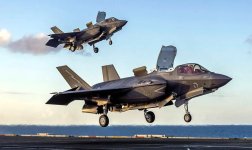
Why was the RAF not training before they even got F35s ?
The U.K. Ministry of Defense is facing growing questions about the progress of
its F-35 program, after key shortcomings were outlined in
a recent critical report from the Public Accounts Committee, a body that examines the value for money of government projects. As well as the adverse effect on the program of years of cost-cutting, the F-35B still critically
lacks a standoff strike capability.
In particular, the committee found that a shortage of maintenance engineers is having a profound effect on F-35B availability and output. During Parliamentary questions in the House of Commons, Ben Obese-Jecty, a Conservative member of parliament, asked the Ministry of Defense how long it would take to fix these issues.
In response, Luke Pollard, minister of state at the Ministry of Defense, said that the maintenance engineer shortages would not be fixed for three to four years, although steps had been taken in this direction, including a “significant” increase in the recruitment of engineers over the last two years. These efforts have included boosting training capacity as well as sign-on bonuses for new recruits.
According to the Public Accounts Committee report,
The U.K.’s F-35 capability, the shortage of qualified engineers in the Royal Air Force (RAF) came about due to a failure to determine exactly how many of these critical staff would be needed. As a result, this is now one of the main reasons behind the F-35’s availability being judged “poor” and the jet consistently failing to meet targets.
“The Ministry of Defense has introduced a program of surging recruitment for the RAF so that it returns to workforce balance across every specialization,” Pollard
explained. “This activity includes a significant focus on the engineer profession where, over the last two years, the RAF has offered joining bonuses and increased the capacity of technical training schools to enable more recruits to be trained. To improve retention, the RAF has implemented a Financial Retention Incentive for engineers. The recruitment and retention of personnel remains one of the top two priorities for the chief of the defense staff.”
While it’s true that the U.K. Armed Forces, in general, are suffering from a lack of technical support staff, it remains embarrassing that, in the case of the F-35B, the Ministry of Defense simply “miscalculated how many engineers would be needed per plane,” by failing to take into account staff taking leave and performing other tasks.
Overall, the Public Accounts Committee judges the F-35 “the best fast jet the United Kingdom has ever had.”
The jet is currently operated by two frontline units, the RAF’s No. 617 Squadron, the “Dambusters,” and the Royal Navy’s
809 Naval Air Squadron (NAS), as well as a training unit, No. 207 Squadron, RAF, which serves as the Operational Conversion Unit (OCU). All of these are home-based at RAF Marham in England,
the main operating hub when the jets are not embarked in one of the two Royal Navy aircraft carriers or deployed on operations. As of this summer, 38 F-35Bs had been delivered, with one of these
lost in a carrier accident in the Mediterranean.
The report found that a history of “cost-cutting” throughout the U.K. F-35 program “has caused significant problems in its use,” which have affected the jet’s “capability, availability to fly, and value for money.”
While these issues relate to
the in-service F-35B, the short takeoff and vertical landing (STOVL) version of the jet, the same report also warns that the plan to introduce the conventional takeoff and landing
F-35A version,
which is nuclear-capable, is also likely to run into problems relating to costs and timelines.
When it comes to RAF Marham, the Public Accounts Committee slams the airbase for its “substandard accommodation,” which it described as “shabby, sometimes lacking hot water, and lacking bus access to a local town.”
The report notes that work on infrastructure at Marham won’t be finished until 2034, a “very complacent date,” and one that could further exacerbate problems in personnel retention.
Turning to the aircraft itself, one of the most significant problems caused by the cost-cutting relates to the facility that is required to assess the F-35’s stealth capability. This is critical to ensure that the fighter’s low-observable characteristics are functioning as they should. After all, the jet’s stealth features are key to its evading high-end air defense systems. More broadly, it should be noted that this type of infrastructure is a core requirement of the F-35’s unique capabilities, and constructing and sustaining it comes at an added cost.
To reduce the spending on the program, the Ministry of Defense delayed the investment in the facility, which provided a savings of £82 million (around $107 million) by 2024-25. However, due to inflation, the final cost of completing the facility will add another £16 million (around $21 million) on top of that by 2031-32.
In another effort to save cash in the short term, in 2020, the Ministry of Defense chose to slow down the delivery schedule of the F-35Bs, which had the effect of reducing the number of jets available on the flight lines today. The situation was then compounded by a lack of funds for buying new aircraft in 2020; this meant that seven aircraft were delivered a year late.
Finally, the Ministry of Defense took the decision to delay the full establishment of the first Royal Navy F-35B squadron,
809 NAS, again on budgetary grounds. This means the squadron has to wait until 2029 to get its full infrastructure at Marham. As a result, capability has been reduced and, once again, the eventual spend will be even greater: from £56 million (around $73 million) to a likely £154 million (around $201 million).
With this history of financial mismanagement in the program, the Public Accounts Committee is skeptical about how the Ministry of Defense will manage the introduction of another version of the jet, the F-35A.
After years of speculation, the United Kingdom finally announced this summer that it will buy 12 F-35As.
As we have discussed in the past, this jet offers a number of advantages over the F-35B, but the Ministry of Defense has specifically highlighted its ability to join the NATO nuclear mission, which would see the jets armed with U.S.-owned
B61-12 nuclear gravity bombs. On top of this mission, the RAF says that the new jets will be assigned to the training unit and will primarily be used in that role.
According to the Public Accounts Committee:
“Becoming certified for the NATO nuclear mission will add new requirements to training, personnel, and possibly infrastructure, but discussions in this area are at an early stage, and no indication of forecast costs has been provided by the Ministry of Defense.”
One of those costs could well relate to the secure underground weapons vaults that are required to store the nuclear bombs. Whether such vaults did exist at RAF Marham in the past, it’s unclear whether this infrastructure remains intact or what degree of work it might need to accommodate the B61-12s. Some
reports suggest the vaults have been dismantled or even filled in completely. Making use of U.S.-operated vaults at nearby
RAF Lakenheath could be another option.
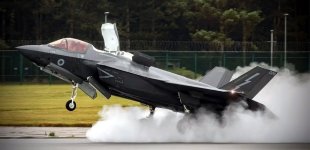


 And that was the worlds fastest supersonic advanced trainer way back in 1961 , I had plastic kit model of one when I was kid .