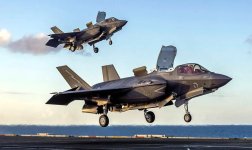
US Navy's Newest Fighter Jets

Chuffer

CCCUK Member

NASA's X-59 'quiet' supersonic jet makes historic 1st flight today​

NASA's X-59 has finally taken flight.

The X-59 is NASA's experimental new jet built to break the sound barrier without generating the thunderous sonic booms typically associated with supersonic flight.

After taxiing out of the U.S. Air Force's (USAF) Plant 42 facility, the X-59 took off from the Palmdale Regional Airport in California today (Oct. 28) at 10:13 a.m. EDT (1413 GMT), according to aircraft tracker Flightradar24.
The airport and USAF facility share a runway.
Videos and photos were posted to social media by aircraft spotters and photographers, showing the radically elongated X-59 taking off before flying north out of Palmdale. Photographer Jarod Hamilton caught the X-59 as it left the ground, making a steep climb into the air above the Mojave Desert.
Based on the X-59's track, it appears the X-plane flew oval-shaped "racetrack" patterns over the U.S. Air Force's Edwards Air Force Base for just over an hour before landing at the facility.

NASA's Armstrong Flight Research Center is located at the base. After this first flight, the X-59 will now reside at Armstrong, where it will undergo a testing campaign that will involve flying the jet over microphones placed throughout the desert and trailing other aircraft equipped with special air sensors through its shockwaves .

The X-59 was designed by NASA and built by Lockheed Martin at the company's storied Skunk Works facility in Palmdale. The aircraft was designed from the wheels up to be able to fly faster than the speed of sound without producing loud sonic booms, which can be disruptive to people on the ground below. Because of those booms, supersonic flight has been prohibited above land within a certain distance of the U.S. since 1973.

View attachment 31920View attachment 31921
Looks a bit like Northrop T - 38 Talon streeeeeaaaached to the limit ! :LOL: And that was the worlds fastest supersonic advanced trainer way back in 1961 , I had plastic kit model of one when I was kid .
 

Roscobbc

Moderator
Looks a bit like Northrop T - 38 Talon streeeeeaaaached to the limit ! :LOL: And that was the worlds fastest supersonic advanced trainer way back in 1961 , I had plastic kit model of one when I was kid .
Makes me laugh......we have idiots out there now believing and inferring that we'll be seeing passenger airliners flying at speeds in excess of Mach 1 in the next few months FFS. The X59 is just a test bed to prove the theory.....translating that in to regular passenger transport for the masses will never happen.....even for the wealthy elite it'll take many years before we see it.
 

Chuffer

CCCUK Member
Makes me laugh......we have idiots out there now believing and inferring that we'll be seeing passenger airliners flying at speeds in excess of Mach 1 in the next few months FFS. The X59 is just a test bed to prove the theory.....translating that in to regular passenger transport for the masses will never happen.....even for the wealthy elite it'll take many years before we see it.
A bit late to the party ! Concord has had been there and done that years ago !!
 

antijam

CCCUK Member
A bit late to the party ! Concord has had been there and done that years ago !!
....but not without the 'boom'. My first professional job was as a design engineer on Concorde and the aerodynamic compromises on the form of the aircraft were even then a constraint on the payload capacity - Concorde cabin space was very restricted compared to contemporary subsonic passenger aircraft.
While the X59 may well offer solutions to achieving 'boom-less' supersonic flight it's difficult to see the current shape being compatible with commercial passenger flight.
While many countries, including the UK and USA curtailed supersonic flight by Concorde over land, the French were less restrictive. Back in the 80's and 90's we had an old farmhouse in France that I was renovating.....

cid_D248C5C68FE249ADA5FDF80555E2ACDENickPC_zpsf8gbdkp6.jpg
....and this had a slate roof. Many times when I was working up in the loft Concorde would pass over and the shock wave would rattle every one of the slates, making me jump out of my skin! o_O
Had Concorde been capable of 'silent' supersonic flight this would have certainly improved its economic viability, but I don't think the X59 heralds a new era of supersonic transport just yet.
 

Chuffer

CCCUK Member
....but not without the 'boom'. My first professional job was as a design engineer on Concorde and the aerodynamic compromises on the form of the aircraft were even then a constraint on the payload capacity - Concorde cabin space was very restricted compared to contemporary subsonic passenger aircraft.
While the X59 may well offer solutions to achieving 'boom-less' supersonic flight it's difficult to see the current shape being compatible with commercial passenger flight.
While many countries, including the UK and USA curtailed supersonic flight by Concorde over land, the French were less restrictive. Back in the 80's and 90's we had an old farmhouse in France that I was renovating.....

View attachment 31935
....and this had a slate roof. Many times when I was working up in the loft Concorde would pass over and the shock wave would rattle every one of the slates, making me jump out of my skin! o_O
Had Concorde been capable of 'silent' supersonic flight this would have certainly improved its economic viability, but I don't think the X59 heralds a new era of supersonic transport just yet.
I well remember the French Concord out on test flights in 1970 from memory . Me and my mates had been bumming around France and Spain in our old Commer Van and we camped outside Biarritz for a week . Several times Concord flew over heading out over the Atlantic , the noise was awesome !!
 

Roscobbc

Moderator
It seem whilst the X59 would appear to remove the sonic boom as we know it........seems to transpose the 'boom' into excess noise (which I guess will have the tree huggers and enviromentalist condeming it).
 

teamzr1

Supporting vendor
The U.K. Royal Navy flagship, HMS Prince of Wales, is now carrying 24 US made F-35B fighters, the largest number of the jets to go aboard either of the U.K.’s two aircraft carriers, or any ship, for that matter.
All 24 of the jets are British, a significant achievement for the British F-35 force, which has long-faced questions about the feasibility of deploying a meaningful number of the short takeoff and vertical landing (STOVL) jets at sea, without U.S. Marine Corps aircraft making up the numbers.

The Royal Navy announced today that the 24 British F-35Bs were aboard HMS Prince of Wales for planned multinational maneuvers in the Mediterranean, Exercise Falcon Strike. The service has not so far published photos showing all the jets on deck, instead posting imagery from Operation Highmast, the eight-month cruise that took the carrier to the Indo-Pacific region.

HMS Prince of Wales entered the Mediterranean, via the Suez Canal, around a week ago. Six additional British F-35Bs embarked in the carrier once it had arrived in the Med, flying from their base at RAF Marham in England.

As part of the U.K. Carrier Strike Group, the conventionally powered HMS Prince of Wales is accompanied by the Type 45 destroyer HMS Dauntless, the Type 23 frigate HMS Richmond, the replenishment tanker RFA Tidespring, and several allied ships. A Royal Navy Astute class nuclear-powered attack submarine is normally also part of the Carrier Strike Group.

For Exercise Falcon Strike, the U.K. Carrier Strike Group is joined by the Italian frigate Luigi Rizzo, as well as Norwegian warships, for what are Italian Navy-led air and maritime maneuvers.

Commodore James Blackmore, commander of the U.K. Carrier Strike Group, said that Falcon Strike is “a real demonstration of the warfighting readiness” of the group.

The British F-35Bs on the carrier are from the two frontline units, the Royal Air Force’s No. 617 Squadron and the Royal Navy’s 809 Naval Air Squadron, as well as from the training unit, No. 207 Squadron, RAF, which serves as the Operational Conversion Unit (OCU).

It’s notable that, in the past, larger F-35B complements on U.K. carriers were assisted by detaching U.S. Marine Corps aircraft during these cruises.

For example, in 2021, HMS Queen Elizabeth deployed with a Marine Corps-augmented air wing. On that occasion, eight F-35Bs from No. 617 Squadron were joined by 10 from Marine Fighter Attack Squadron (VMFA) 211, the “long.” This total is still smaller than the current F-35B complement for Exercise Falcon Strike.

The number of F-35Bs now on HMS Prince of Wales is also bigger than has been deployed aboard any amphibious assault ship by the Marine Corps. Back in 2022, the USS Tripoli (LHA-7) hosted 20 of the jets during a test of the “Lightning Carrier” concept. This is based upon essentially turning a big-deck “Gator Navy” amphibious assault ship into a light aircraft carrier, packed with F-35Bs.

The biggest carrier embarkation involving fifth-generation fighters also makes an interesting parallel with developments in China, which is now also flying the J-35 stealth fighter, as well as fixed-wing airborne early warning and control (AEW&C) aircraft from its latest flattop, the Fujian. Elsewhere in the Indo-Pacific region, Japan is meanwhile preparing for regular F-35B operations aboard its two amphibious assault ships that have been modified to become STOVL carriers.

Having a larger number of F-35Bs on board the British carrier means that HMS Prince of Wales can contribute more to Falcon Strike, which also involves air assets from France, Greece, Italy, and the United States.

More importantly, a carrier deployment with 24 British F-35Bs is a major requirement for the declaration of full operating capability for the U.K. Carrier Strike capability, once planned for 2023, then delayed to the end of this year. A 24-aircraft total is the minimum required for this declaration, with the Queen Elizabeth class having the capacity to embark more jets, if required.
The move toward full operating capability is also welcome, considering recent criticism of the British F-35 program.

Untitled-1.jpg
 

teamzr1

Supporting vendor
Last week, the U.K.’s Public Accounts Committee released its latest report on the programme. Among others, this highlighted the effects of a lack of overall investment in the program. According to the report, cost-cutting measures have had an adverse impact on the F-35B’s capability, availability to fly, and value for money.

The number of British F-35Bs that will ultimately be available to the Royal Navy’s two carriers has long been a matter of intense debate.

To date, the United Kingdom has only placed firm orders for 48 F-35Bs. The previous Conservative government confirmed it was negotiating to buy another 27 F-35Bs for delivery by 2033. However, this batch of 27 jets will now be divided between F-35As (12) and F-35Bs (15). The conventional takeoff and landing F-35A offers a number of advantages, including being cheaper, possessing a bigger weapons bay, having a nuclear capability, and improved performance in many scenarios. However, it cannot embark on a carrier.

Most analysts consider that many more than 48 F-35Bs would be required to meet the ambition of 24 jets available for the baseline Carrier Strike mission, across two carriers, as opposed to just one. Considering training and other demands, a figure of 60–70 jets is generally thought to be reasonable.
It is for this reason that U.S. Marine Corps F-35Bs have been relied upon to make up the required aircraft numbers during carrier cruises.

Officially, at least, the U.K. Ministry of Defense says that it still expects to procure 138 F-35s over the lifetime of the program. However, this total now includes at least 12 F-35As. Having a smaller pool of F-35Bs will also put more strain on the fleet of STOVL jets that are required for missions aboard the carriers.

Whatever the final F-35B numbers, the Royal Navy is increasingly looking to the potential of uncrewed aircraft to bolster its carrier air wings. The Royal Navy hopes that a combination of drones and long-range weapons will help to make a more balanced ‘hybrid carrier air wing,’ as you can read about here.

In 2023, the Royal Navy revealed details of its plan to fit its two carriers with assisted launch systems and recovery gear, enabling operations by a variety of fixed-wing uncrewed aircraft and, potentially, also conventional takeoff and landing crewed types.

“We are looking to move from STOVL to STOL, then to STOBAR [short takeoff but arrested recovery], and then to CATOBAR [catapult assisted takeoff but arrested recovery],” Colonel Phil Kelly, the Royal Navy’s Head of Carrier Strike and Maritime Aviation, told the Combined Naval Event conference in 2023. “We are looking at a demonstrable progression that spreads out the financial cost and incrementally improves capability.”

By the time a British carrier makes its next scheduled deployment to the Indo-Pacific, planned for 2029, the Ministry of Defense hopes that it will include some kind of collaborative combat aircraft (CCA). This aspiration was laid out by First Sea Lord General Sir Gwyn Jenkins earlier this year, when he said he wanted to “launch the first jet-powered collaborative platform drone as a concept demonstrator off a Queen Elizabeth class aircraft carrier” before the end of 2026.

Nevertheless, for the foreseeable future, the F-35B remains the cornerstone of the carrier air wing’s strike capability. Putting the largest number of the stealth jets on a Royal Navy carrier is a visible demonstration of the aircraft’s central role and underscores the British F-35Bs’ progress, despite lingering concerns over final aircraft numbers and other criticisms of the program.
 

teamzr1

Supporting vendor
Interesting this was reported in USA News
Sounds like they forgot to design in the puke bags ! :)

The British Army has suspended the use of its controversial new Ajax armored fighting vehicles after dozens of soldiers became ill after riding in them.
The U.K. Ministry of Defense confirmed that “around 30 personnel presented noise and vibration symptoms” following an exercise involving the tracked vehicles.

The Ministry of Defense said that the Army immediately put a two-week pause on using Ajax, following Exercise Iron Fist conducted on Salisbury Plain over the weekend. The ministry added that the “vast majority” of the soldiers affected “have now been medically cleared and are continuing on duty.” Others, however, “continue to receive expert medical care.”
The statements were provided to Sky News by a Ministry of Defense spokesperson. Reportedly, the affected soldiers spent between 10 and 15 hours in the vehicles.

The decision was made by Luke Pollard, the defense procurement minister, and will now see a safety investigation carried out on the armored fighting vehicles. In the meantime, the Ministry of Defense said that “a small amount of testing of the vehicle will continue, in order to ensure that any issues can be identified and resolved.”

Perhaps most troubling is the fact that these kinds of issues are by no means new for the vehicle.
In the summer, soldiers were hospitalized after suffering hearing and other injuries caused by loud noise and vibrations inside the vehicles.

Earlier this month, the Ministry of Defense confirmed that a “small number” of soldiers had reported noise and vibration issues after trials that involved three variants of the tracked vehicle.
However, a ministry spokesperson also told Deborah Haynes of Sky News that, following an investigation, “no systemic issues were found.”

Also in November, defense procurement minister Pollard said that “After all the problems [Ajax] may have had in the past, we have put those to bed now.”

Pollard was speaking as the Ministry of Defense announced the initial operating capability (IOC) for Ajax. This milestone required a squadron of 27 vehicles ready to deploy on operations from a pool of 50.
By this point, 165 of the vehicles had been delivered from a total of 589 on order, in six different versions (Atlas armored recovery vehicle, Apollo armored repair vehicle, Ares armored personnel carrier, Ajax reconnaissance vehicle, Athena command post vehicle, and Argus engineering vehicle).

The nature of the noise and vibration problem was already well known by that point.
In 2021, the Ministry of Defense published a review that revealed that, for almost two years, senior officers and ministry officials were aware of problems with the vehicles that put troops at risk.

The same review noted that, although the potential for hearing damage had been identified in December 2018, it wasn’t until November 2020 that trials were suspended for the first time. A year later, more than 300 soldiers had been offered hearing tests, and 17 of them were still receiving specialist treatment.

As well as these problems, the Ajax program has seen serious delays.
At one point, IOC was expected in 2017. In June 2021, the Ministry of Defense said that, although IOC had been delayed by another year, it had “90 percent confidence” that it would be declared in September 2021. Ultimately, the Army would have to wait until November 2025 for that milestone.

The summer of 2021 also saw a damning report into Ajax from the Royal United Services Institute (RUSI), a British defense and security think tank.

That report described it as a program in crisis, highlighting the vehicle’s excessive noise and vibration and asking what it said were the two fundamental questions about Ajax: “Whether the vehicle can be fixed, and whether it is worth saving.”
The RUSI report also provided more details on how the noise and vibration issues manifest themselves.

Taking noise first, RUSI reported that the main problem was due to the integration of the Bowman headsets for the crew radios. These headsets picked up the engine noise from what “has long been recognized as a noisy vehicle” and put the sound directly into the crews’ ears. While that problem can clearly be fixed with different headsets, it does raise alarming questions about how these noise tests were carried out.

Second and more worrying is the vibration issue, which is at least partly derived from problems with quality control in the fabrication of the vehicle hulls by General Dynamics Land Systems UK (GDLUK). The vibration not only leads to significant crew discomfort but also has other effects: “Preventing the main armament from stabilizing on the move, damaging the electronic systems that make Ajax a step-change in capability, and leading to a high rate of component failure, with the idler and rear road wheels shearing off with concerning regularity.”

If the future of the Ajax program was questionable in 2021, it is even more precarious now.
What is clear is that the British Army badly needs modern armored fighting vehicles.

The Ajax is the first new tracked armored fighting vehicle for the Army in almost 30 years. Some of the equipment it’s replacing, like the FV432 armored personnel carrier, dates back to the 1960s.

Armed with a 40mm main gun, the Ajax is based on the ASCOD 2 armored fighting vehicles used by Spain and Austria and was selected by the United Kingdom in 2010 as the winner of the Future Rapid Effect System contract.
 

teamzr1

Supporting vendor
Why was the RAF not training before they even got F35s ?

The U.K. Ministry of Defense is facing growing questions about the progress of its F-35 program, after key shortcomings were outlined in a recent critical report from the Public Accounts Committee, a body that examines the value for money of government projects. As well as the adverse effect on the program of years of cost-cutting, the F-35B still critically lacks a standoff strike capability.

In particular, the committee found that a shortage of maintenance engineers is having a profound effect on F-35B availability and output. During Parliamentary questions in the House of Commons, Ben Obese-Jecty, a Conservative member of parliament, asked the Ministry of Defense how long it would take to fix these issues.

In response, Luke Pollard, minister of state at the Ministry of Defense, said that the maintenance engineer shortages would not be fixed for three to four years, although steps had been taken in this direction, including a “significant” increase in the recruitment of engineers over the last two years. These efforts have included boosting training capacity as well as sign-on bonuses for new recruits.

According to the Public Accounts Committee report, The U.K.’s F-35 capability, the shortage of qualified engineers in the Royal Air Force (RAF) came about due to a failure to determine exactly how many of these critical staff would be needed. As a result, this is now one of the main reasons behind the F-35’s availability being judged “poor” and the jet consistently failing to meet targets.

“The Ministry of Defense has introduced a program of surging recruitment for the RAF so that it returns to workforce balance across every specialization,” Pollard explained. “This activity includes a significant focus on the engineer profession where, over the last two years, the RAF has offered joining bonuses and increased the capacity of technical training schools to enable more recruits to be trained. To improve retention, the RAF has implemented a Financial Retention Incentive for engineers. The recruitment and retention of personnel remains one of the top two priorities for the chief of the defense staff.”

While it’s true that the U.K. Armed Forces, in general, are suffering from a lack of technical support staff, it remains embarrassing that, in the case of the F-35B, the Ministry of Defense simply “miscalculated how many engineers would be needed per plane,” by failing to take into account staff taking leave and performing other tasks.

Overall, the Public Accounts Committee judges the F-35 “the best fast jet the United Kingdom has ever had.”

The jet is currently operated by two frontline units, the RAF’s No. 617 Squadron, the “Dambusters,” and the Royal Navy’s 809 Naval Air Squadron (NAS), as well as a training unit, No. 207 Squadron, RAF, which serves as the Operational Conversion Unit (OCU). All of these are home-based at RAF Marham in England, the main operating hub when the jets are not embarked in one of the two Royal Navy aircraft carriers or deployed on operations. As of this summer, 38 F-35Bs had been delivered, with one of these lost in a carrier accident in the Mediterranean.

The report found that a history of “cost-cutting” throughout the U.K. F-35 program “has caused significant problems in its use,” which have affected the jet’s “capability, availability to fly, and value for money.”

While these issues relate to the in-service F-35B, the short takeoff and vertical landing (STOVL) version of the jet, the same report also warns that the plan to introduce the conventional takeoff and landing F-35A version, which is nuclear-capable, is also likely to run into problems relating to costs and timelines.

When it comes to RAF Marham, the Public Accounts Committee slams the airbase for its “substandard accommodation,” which it described as “shabby, sometimes lacking hot water, and lacking bus access to a local town.”

The report notes that work on infrastructure at Marham won’t be finished until 2034, a “very complacent date,” and one that could further exacerbate problems in personnel retention.

Turning to the aircraft itself, one of the most significant problems caused by the cost-cutting relates to the facility that is required to assess the F-35’s stealth capability. This is critical to ensure that the fighter’s low-observable characteristics are functioning as they should. After all, the jet’s stealth features are key to its evading high-end air defense systems. More broadly, it should be noted that this type of infrastructure is a core requirement of the F-35’s unique capabilities, and constructing and sustaining it comes at an added cost.

To reduce the spending on the program, the Ministry of Defense delayed the investment in the facility, which provided a savings of £82 million (around $107 million) by 2024-25. However, due to inflation, the final cost of completing the facility will add another £16 million (around $21 million) on top of that by 2031-32.

In another effort to save cash in the short term, in 2020, the Ministry of Defense chose to slow down the delivery schedule of the F-35Bs, which had the effect of reducing the number of jets available on the flight lines today. The situation was then compounded by a lack of funds for buying new aircraft in 2020; this meant that seven aircraft were delivered a year late.

Finally, the Ministry of Defense took the decision to delay the full establishment of the first Royal Navy F-35B squadron, 809 NAS, again on budgetary grounds. This means the squadron has to wait until 2029 to get its full infrastructure at Marham. As a result, capability has been reduced and, once again, the eventual spend will be even greater: from £56 million (around $73 million) to a likely £154 million (around $201 million).

With this history of financial mismanagement in the program, the Public Accounts Committee is skeptical about how the Ministry of Defense will manage the introduction of another version of the jet, the F-35A.

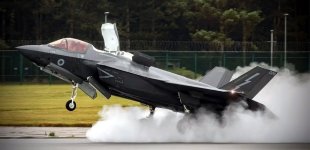
After years of speculation, the United Kingdom finally announced this summer that it will buy 12 F-35As. As we have discussed in the past, this jet offers a number of advantages over the F-35B, but the Ministry of Defense has specifically highlighted its ability to join the NATO nuclear mission, which would see the jets armed with U.S.-owned B61-12 nuclear gravity bombs. On top of this mission, the RAF says that the new jets will be assigned to the training unit and will primarily be used in that role.

According to the Public Accounts Committee:

“Becoming certified for the NATO nuclear mission will add new requirements to training, personnel, and possibly infrastructure, but discussions in this area are at an early stage, and no indication of forecast costs has been provided by the Ministry of Defense.”

One of those costs could well relate to the secure underground weapons vaults that are required to store the nuclear bombs. Whether such vaults did exist at RAF Marham in the past, it’s unclear whether this infrastructure remains intact or what degree of work it might need to accommodate the B61-12s. Some reports suggest the vaults have been dismantled or even filled in completely. Making use of U.S.-operated vaults at nearby RAF Lakenheath could be another option.


F35a.jpg
 

teamzr1

Supporting vendor
When the F-35A decision was announced, TWZ also highlighted the potential disadvantages of a mixed fleet, especially with only a dozen of these versions, which represents very much a token force:

“A fleet of just 12 jets adds another type with some different maintenance and infrastructure requirements, and a relatively low availability rate, at least historically. At the same time, the training that it offers is not 1:1 for the STOVL F-35B, and it is questionable whether it will save money in the long run. That would change, however, if the British were to buy A-models in bigger numbers.”

Reports of Ministry of Defense financial mismanagement on the F-35 program also hardly inspire confidence in the even more ambitious plan for the Global Combat Air Program (GCAP), the United Kingdom’s future air combat initiative at the heart of which is the Tempest crewed stealth fighter.

As we have discussed before, the future of the GCAP program is by no means certain.

In the past, we have suggested that, should the F-35A prove itself with the RAF, that could open up the possibility of a follow-on purchase, and larger numbers of this version that would be a very obvious threat to the future of the Tempest.

That, however, likely depends on the Ministry of Defense solving the issues with the ongoing fielding of the F-35.

In summing up the U.K. F-35 program, Sir Geoffrey Clifton-Brown, the chair of the Public Accounts Committee, likened the mismanagement to a homeowner choosing to delay making repairs to a leaky roof, noting that “making short-term cost decisions is famously inadvisable … and yet such decisions have been rife in the management of the F-35.”

The Public Accounts Committee doesn’t provide a final figure for the U.K. F-35 program’s whole-life cost but does state that the Ministry of Defense’s projection of £57 billion (around $75 billion) through to 2069 “is unrealistic.”

Meanwhile, the additional capabilities that are promised under the latest Block 4 standard will represent another huge investment, but one that is required to ensure the jets perform to their fullest potential. The implications of Block 4 are also yet to be fully understood in terms of cost perspective, but will certainly be very significant.

By way of comparison, the United Kingdom expects to pay £31 billion (around $40 billion) for the design and manufacture of its four new Dreadnought class nuclear-powered ballistic missile submarines, including inflation over the life of the program.

The committee also notes that the Ministry of Defense’s figure does not include costs for personnel, fuel, and infrastructure.

While the financial side of the program is worrying, of more immediate concern for the U.K. Armed Forces is the fact that key capabilities are still missing from its F-35s. While full operating capability was recently declared, after demonstrating the ability to put 24 U.K.-owned F-35Bs on a single carrier, this milestone remains somewhat aspirational, since the personnel shortages are still to be properly addressed.
 

CaptainK

Moderator
I saw an article elsewhere, probably BBC news, about the Ajax. My first thoughts were how did the folks fighting in the first tanks made during WWI cope? I've seen some of those tanks, seen documentaries about them etc and they literally sat crammed in next to an open engine with cannon sounds also ringing right through their basic tin can structure. The noise, vibrations, and pollution within those old tanks must have been horrendous.
 
Top