1968 C3 fuel venting system

CaptainK

Administrator
So, my 1968 C3 (with original 327/300hp engine and 4 speed manual) stinks a bit of fuel and has done for a while now. Not really bothered me much as don't use it much and its just the joys of old cars, but figured I'd look into it now.

Now, remember this is a 1968 C3 meaning first year fun that won't apply to later years.

According to my searching on the internet, and talking to AIs, my 1968 car may or may not have a charcoal / vapor canister. Great they are consistent :rolleyes::ROFLMAO:

Anyway, first thing I thought I'd replace is the fuel tank cap as it does stink a bit there and easy for me to replace. Which is when I found out I appear to have the wrong tank cap on my 1968 car. According to the internet where I can buy stuff for Corvettes, the 1968 - 1970 Corvette had a VENTED cap on it. However, my 1968 car has a SEALED cap on it that was for 1970 onwards. This should mean my car would exhibit fuel starvation / vacuum in the tank issues. But it doesn't. It drives fine except for a smell of petrol, and I don't get a sudden rush of air when I open the petrol cap.

Hence I thought I'd post here to see if any of you wonderful people could clarify - how does the 1968 (specifically 1968) Corvette vent its fuel system? And should I put the VENTED fuel cap back on as per what the 1968 spec says? And if so, what's the best place in the UK to get one?

Oh and any other thoughts of why the car smells of petrol would be appreciated. Can't see any leaks anywhere.

Thanks.
 

Roscobbc

Moderator
The short rubber pipe connection from tank to hard line on mine perished, initially smelling of petrol.....and later weeping fuel.
 

CaptainK

Administrator
The short rubber pipe connection from tank to hard line on mine perished, initially smelling of petrol.....and later weeping fuel.
Is that a tank out job to replace that? I had been thinking about replacing all my rubber lines at some point, as gosh knows how old they are.

And urrgghh.... ordering a cap from the likes or Rockauto etc appears to have the fun of "sorry, won't deliver, can't determine Russian steel" :rolleyes:
 

Oneball

CCCUK Member
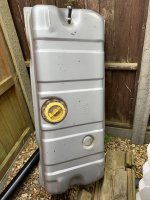
I believe the 1968-9 cars had a vent tube on the top of the tank, that goes to a can. Here’s a photo of mine. IMG_4393.jpeg

My car was odd in a lot of ways though, it was an early 69 and had a number of bits that all the books said were 68 only.
 

Roscobbc

Moderator
Oneball - was yours a single feed to fuel pump,? - mine is feed and return line to tank........so presumably no need for vent?
And K - the rubber tube from tank to fuel line is perhaps less than 12" if I recall.
Several years use now of ethanol content fuel in UK will no doubt accelerate any rubber tube degrading.
 

teamzr1

Supporting vendor
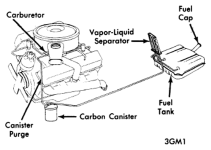
IF your engine had a carbon canister
Follow hose from carb as shown and also if the top of tank has a vapor-liquid separator

But GM stated :

Evaporation Control System (ECS) is designed to minimize the escape of fuel vapors to the atmosphere. Included in the system are a special fuel tank and filler cap, liquid-vapor separator, carbon canister, canister purge hoses, and carburetor modifications.
Fuel vapors which would otherwise escape to the atmosphere are directed into the carbon canister.
The carbon adsorb the vapors and stores them.
The vapor is removed from the canister during periods of engine operation as manifold vacuum draws the vapors into the engine and burns them.

This system was first released in 1970 for vehicles originally sold in California.
In 1971, the Federal Government required that all trucks with a gross weight of less than 6, 000 lbs., were to be equipped with such a system.


C3evap.png
 

teamzr1

Supporting vendor
The fuel tank is an integral part of the Evaporation Control System. In order to collect as much vapor as possible, the fuel level was reduced by lowering the filler neck from the highest point of the tank by approximately one inch.

This allows room for expansion and vapor collection on top of the liquid.


Fuel venting occurs at three positions on the tank.
These vents allow fuel and fuel vapors to flow from the top of the tank to the liquid-vapor separator.

In order to prevent a vacuum collapse or pressure expansion, the fuel tank cap has been modified to release excess pressure or allow additional air to enter during stages of high vacuum.
The cap also has dual locking action.
The second set of ears on the cap provides a slow bleed of any residual fuel tank pressure when the cap is removed.

Fuel Vapor Storage Canister​

The canister is located in the engine compartment of the vehicle and contains approximately 1 1/2 lbs. of activated charcoal.
During periods of vehicle in-operation, vapors coming off fuel tank are absorbed and stored in the charcoal. When the engine is started, stored vapors are drawn off the carbon by fresh air entering the bottom of the canister.
Any vapors coming off the fuel tank during vehicle operation by pass the carbon bed and are inducted directly into the engine via the idle purge restrictor.
 
Last edited:

Oneball

CCCUK Member
Oneball - was yours a single feed to fuel pump,? - mine is feed and return line to tank........so presumably no need for vent?
And K - the rubber tube from tank to fuel line is perhaps less than 12" if I recall.
Several years use now of ethanol content fuel in UK will no doubt accelerate any rubber tube degrading.
There were two lines, maybe that was the return then and I’m remembering wrong. IMG_5856.jpeg
 

Roscobbc

Moderator
I seem to remember the application of the dual fuel line (supply and return) was used to minimise percolation issues where (presumably) the supply line being in close proximity to the engine could be affected by heat.......logic being that circulating fuel back to the tank helped reduce the temperature of the fuel.
One would naturally expect to see this system on engines in a higher state of tune.....perhaps if also using A/C.
A good idea perhaps - I certainly think so - although a rule of 'diminishing-returns' (apologies for the pun!) would mean that on a long journey in hot weather the cooling effect would reduce ultimately especially as fuel level in the tank lowered).
Oddly (if I'm correct) the engine one would expect to see this fitted to (so 425 hp 427) I don't think had it........yet my 390 hp L36 'did' have it fitted.......weird perhaps?
 
Top