Are we still convinced that electric vehicles are the best way forward?

CaptainK

Administrator
Was travelling up the M1 recently in my mates new Audi and thought it was tram lining the HGV ruts but he said it was the Lane Assist taking over . Bloody aweful experience and just another `toy` that supposedly compensates for crap drivers that can`t drive properly !!
Tell me about it. Thankfully there is an OFF switch to it, but frustratingly you have to do it EVERY TIME you turn the ignition on. Even when its not trying to kill me, with it on and going around corners, it just makes the car feel "skittish" like its got less grip on the road. Horrid feeling.
 

teamzr1

Supporting vendor
Long term costs in owning a EV

One owner :

Finally decided to replace the HV battery in my 2014.
I have been having the ICE run before 0 EV miles intermittently for almost a year now, usually only when cold.
I also had a charging session stop after an hour, followed by a full week of unable to charge.

Furthermore, I ordered the battery (reconditioned cells) from Best Hybrid Batteries on Tuesday, March 5th, and it is being delivered to their white glove installer Curt's Service today, March 7th. Total cost of battery, including shipping is $6075.00
Quoted installation price is $1794.90 and told they would have to have the car for at least 1 week
That is $8,000 for a 10-year-old car that has a low selling resale value
 

Roscobbc

Moderator
Long term costs in owning a EV

One owner :

Finally decided to replace the HV battery in my 2014.
I have been having the ICE run before 0 EV miles intermittently for almost a year now, usually only when cold.
I also had a charging session stop after an hour, followed by a full week of unable to charge.

Furthermore, I ordered the battery (reconditioned cells) from Best Hybrid Batteries on Tuesday, March 5th, and it is being delivered to their white glove installer Curt's Service today, March 7th. Total cost of battery, including shipping is $6075.00
Quoted installation price is $1794.90 and told they would have to have the car for at least 1 week
That is $8,000 for a 10-year-old car that has a low selling resale value
I thought for a moment Jon this was you.........but realised it was a 'clip' from another publication.
One of the reasons why Toyota's Prius (and Honda's Insight) hybrids were 'gobbled up' by Uber users firstly in London as initially they were exempt from Londons congestion charge (and later the inner London low emission zone). Ubers were laughing even with several hundred thousand miles on the clock because our annual MOT tests don't check the state of the hybrid battery - if it's knackered it doesn't matter as the test only measures tailpipe emissions........so they can carry on using them with no fears of failing annual tests. Some of the early Tesla's are now 10 years old. It'll be intersting to hear stories of battery replacement costs for them.
 

teamzr1

Supporting vendor
Be a cold day in hell before I bought one, they could not even give me one

I've mentioned before the state of N.Y had bought hundreds of these and slowly over time they were not seen on the streets
Was found later the state abandoned them in 2 fields covered in trees and high weeds because the costs to replace the batteries
was so costly that they could not afford it, so cheaper just to dump them all and hide it from the taxpayers

Hertz rental also had bought hundreds of these and costs of having them so high they are dumping them and the CEO
of Hertz would was the cause of the huge money loss was just fired along with others there

Most electric in the USA, the lines are buried deep in the ground, no electric wires above
where I live there are over 250 units, the main breaker panel is about the middle of the unit, so there is no way to easily add new wires
where garage is all the way around the buildings, no basements or attics above to add 40-50 amp wiring
So totally stupid on all this as installing chargers is impossible

Aholes Feds last week snuck in a law no going after all gas or diesel trucks stating they all have to be gone within 8 years and 8 states
have demanded the same for gas vehicles
 

teamzr1

Supporting vendor
So are people in Europe wising up ?

Electric vehicle (EV) sales plunged across Europe in March as demand dried up despite the E.U.’s push to ban petrol and diesel vehicles by the middle of the next decade.

The Daily Telegraph reports sales of battery-powered cars dropped by 11.3 percent as demand in Germany, Europe’s largest economy, plunged by 28.9 percent, according to the European Automobile Manufacturers’ Association (ACEA).

Only 13 percent of new registrations were electric, down from 13.9 percent in March last year and down from 14.6 percent for all of 2023, continuing a long-term trend,
Overall figures show electric vehicle sales have stalled despite Europe’s plans to ban the sale of new internal combustion engine cars by 2035.

According to the Telegraph report, Volkswagen, Mercedes-Benz and Tesla have all recorded falling electric vehicle sales in the first three months of the year.
It came as new vehicle registrations overall fell by 5.3 percent across the E.U. to one million last month.
The slowdown in EV sales in recent months has not been limited to Europe.

Tesla, for example, saw its deliveries slump in the first quarter for the first annual drop since the start of the pandemic in 2020, missing analyst forecasts in a sign that even price cuts haven’t been able to stave off an increasing consumer skepticism about the long-term EV market
 

Letank

CCCUK Member
Many things have lead to the slow down in EV sales in UK and Europe:
- The reduction of government incentives when purchasing them makes them less attractive than they once were
- Incredibly poor residuals due to lack of confidence in battery durability
- Increasing cost of electricity
- The relaxing and delay of Euro 7 emissions regulations, and lack of any tighter emissions regulations in the UK for the foreseeable future, has allowed OEMs to reconsider their EV role out strategies.

Electric cars are still the future though, whether powered by batteries or fuel cells, so this will only be hiccup in the grand scheme of things.

The legislators drive product change and zero emissions mandates aren’t going away, so sooner or later we’ll all be driving electric vehicles whether we like it or not. ☹️
 

Roscobbc

Moderator
The legislators drive product change and zero emissions mandates aren’t going away, so sooner or later we’ll all be driving electric vehicles whether we like it or not. ☹️
Only because what was once a pleasure has become a chore and in our increasingly congested country we'll each have little opportunity or desire to use personal transport .......so will travel fewer miles and the typical low range of a battery vehicle will perhaps suit that enforced lifestyle (for those able to afford it)
 

Stingray

CCCUK Member
Any form of reciprocating engine is toast due to the inefficiency of pistons stopping, starting and then going back the other way. In many ways it's a great shame the gas turbine never got developed for automotive use, given their popularity in aircraft and some ships. A miniature gas turbine installed in a gas/electric hybrid might have been interesting. I'm thinking range extender use on the motorway rather than 56 jet fighters screaming up your local high street!
 

antijam

CCCUK Member
At the present rate of consumption it's estimated that the world's reserves of fossil fuels will be depleted by 2060 and oil by 2050, certainly in my grandchildren's time. Attempts to reduce greenhouse emissions by reducing fossil fuel consumption are still woefully inadequate to achieve a 1.5°C increase in global warming above pre-industrial levels. Scotland has just announced that its target of reducing greenhouse emissions by 2030 is now 'out of reach'. One way and another any form of fossil fuelled cars will be history well before the end of this century.

Despite being one of the earliest forms of power for personal transport - at the turn of the last century 38% of cars in the States were electric ( 40% were steam! ) - the basic limitation is still the inability to store large amounts of electricity in a compact space. It has improved significantly in recent years and today's electric cars are much more competent than their predecessors, and I've no doubt they'll improve further given the same level of research and development that went into petrol and diesel cars in the past. To make them practical the onus is on governments to provide the infrastructure to support them. That's not an insurmountable problem, the first petrol powered cars had to buy their fuel at the chemist but it didn't take many years for the global network of fuel stations to appear.

At present electricity is the only practical form of energy that can be produced by renewable means and even the hydrogen for fuel cell cars is produced using electricity.
As a car enthusiast I will regret the passing of the internal combustion engine (although at my age its passing is unlikely to happen before mine) but I'm pretty sure my grandchildren will be driving electric.
 

Roscobbc

Moderator
It's interesting looking at that balance of ice, steam and electric vehicles in the USA in the early days of motoring. Electric vehicles were perfect for city use. Given that most major cities were on a railroad longer distance travel and vital supplies were already well catered for and the simplicity and reliability of electric cars were ideal for those local journeys for those who were able to afford a car. With the huge exponential growth of the rail network here in the UK in the late 1800's one would have thought the same scenario could have worked here in the UK.......but perhaps due to the endemic class structure here motorised transport for individuals was seen as something only for wealthy and upper classes.....while the great 'unwashed' could barely afford to repair their shoes, presuming they were able to afford to have bought them in the first place it took several decades and Henry Ford to show the way for the masses here.
 

62 C1

CCCUK Member
1713541053611.png

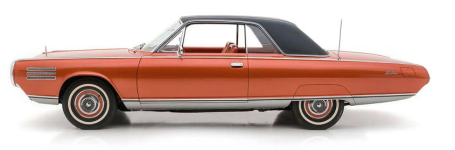
The Chrysler Turbine car had a lot of performance issues but could run on an extremely wide range of fuels from kerosene to jet fuel and including unleaded (didn't like leaded!).

The versatility was underline when the Mexican president ran one on tequila. That is a bio fuel.
 

Chuffer

CCCUK Member
It's interesting looking at that balance of ice, steam and electric vehicles in the USA in the early days of motoring. Electric vehicles were perfect for city use. Given that most major cities were on a railroad longer distance travel and vital supplies were already well catered for and the simplicity and reliability of electric cars were ideal for those local journeys for those who were able to afford a car. With the huge exponential growth of the rail network here in the UK in the late 1800's one would have thought the same scenario could have worked here in the UK.......but perhaps due to the endemic class structure here motorised transport for individuals was seen as something only for wealthy and upper classes.....while the great 'unwashed' could barely afford to repair their shoes, presuming they were able to afford to have bought them in the first place it took several decades and Henry Ford to show the way for the masses here.
During the 1800`s and the development of the new fangled railways , the Duke of Wellington was vehermently opposed to the railways as he proclaimed it would "incourage the great unwashed " to move freely about the country . A classic case of the class structure looking down its nose at us plebs ! Unfortunately the at the height of the UK Railway Building Mania between 1843 and 1845 many thousands of miles of track were constructed as business men , developers and chancers jumped on the band wagon as almost every town and village in the land wanted to be connected to the `new` transport system . Unfortunately many were doomed to be unprofitable and from the start and ran in direct competition to other railway companies linking the same places and were closed long before the infamous ` Beeching ` era . To make matters worse Dr. Beeching was only the `hatchet man ` hired by the government at the time to close down railway routes that had been systematically desimated by the government owned British Railways to make certain routes appear unprofitable to operate . The Great Central Railway mainline connecting the heartlands of the industrial north of England with London was a classic case that was closed in September 1966 ( which is actually now much of the route of the ill fated HS2 ) together with the Somerset & Dorset Railway route that carried thousands of holiday makers every year from the Midlands and further north down to Bournemouth via Bristol and Bath .
And who was Minister of Transport at the time of all this ? None other than Ernest Marples who owned a large road construction company and was hell bent on getting everybody of the railways and into cars . Conflict of interest in politics as as old as the hills !!!
 

Chuffer

CCCUK Member
View attachment 25988

The Chrysler Turbine car had a lot of performance issues but could run on an extremely wide range of fuels from kerosene to jet fuel and including unleaded (didn't like leaded!).

The versatility was underline when the Mexican president ran one on tequila. That is a bio fuel.
And when you got bored with driving you could pull off the highway and get pissed !! :ROFLMAO:
 

Chuffer

CCCUK Member
Any form of reciprocating engine is toast due to the inefficiency of pistons stopping, starting and then going back the other way. In many ways it's a great shame the gas turbine never got developed for automotive use, given their popularity in aircraft and some ships. A miniature gas turbine installed in a gas/electric hybrid might have been interesting. I'm thinking range extender use on the motorway rather than 56 jet fighters screaming up your local high street!
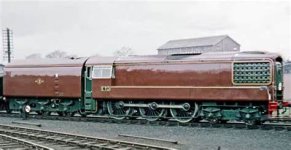
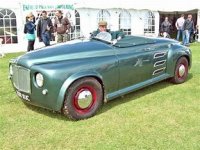
One of the problems with gas turbine power was the high exhaust temperatures produced but a dare say that modern technology might find away to overcome that . British Railways built an experimental gas turbine locomotive called GT3 but it was short lived and would set fire wooden over bridges linking station platforms if came to a stand under them . :eek: Then of course the was the Rover -BRM Gas Turbine car of the early 19560`s that was good for 140 + mph .GT3.jpgRover Gas Turbine.jpg
 

teamzr1

Supporting vendor
We start in the 1830s, with Scotland’s Robert Anderson, whose motorized carriage was built sometime between 1832 and ’39.
Batteries (galvanic cells) were not yet rechargeable, so it was more a parlor trick (“Look! No horse nor ox, yet it moves!”) than a transportation device.
Another Scot, Robert Davidson of Aberdeen, built a prototype electric locomotive in 1837.

A bigger, better version, demonstrated in 1841, could go 1.5 miles at 4 mph towing six tons. Then it needed new batteries.

This impressive performance so alarmed railway workers (who saw it as a threat to their jobs tending steam engines) that they destroyed Davidson’s devil machine, which he’d named Galvani.

Batteries that could be recharged came along in 1859, making the electric-car idea more viable. Around 1884, inventor Thomas Parker helped deploy electric-powered trams and built prototype electric cars in England. By 1890, a Scotland-born chemist living in Des Moines, Iowa, William Morrison, applied for a patent on the electric carriage he’d built perhaps as early as 1887.
It appeared in a city parade in 1888, according to the Des Moines Register. With front-wheel drive, 4 horsepower, and a reported top speed of 20 mph, it had 24 battery cells that needed recharging every 50 miles. Morrison’s self-propelled carriage was a sensation at the 1893 Chicago World’s Fair, also known as the famed World’s Columbian Exhibition.
Morrison himself was more interested in the batteries than in mobility, but he’d sparked the imagination of other inventors.
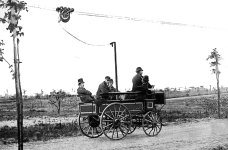
berlin-kurfuerstendamm-.jpg

Only place all electric vehicles really needed, is not on Earth

When NASA contracted Boeing to produce a “car” for use on the moon, electric was the obvious choice for an airless environment.
General Motors’ Delco division was a major subcontractor for the drive-control system and the motors on the Lunar Roving Vehicle
There were four DC motors, one in each wheel, making one-quarter horsepower apiece and capable of up to 10,000 rpm.

Four LRVs were built at a cost of $38 million, an overrun of 100 percent on the original $19 million projection.
Driven nine times (three excursions on each of three missions), it was the most exotic “car” ever.
First deployed on the Apollo 15 mission in 1971 (as shown here), the LRV used non-rechargeable silver-zinc potassium hydroxide batteries with a stated capacity of 121 amp-hours.

Steering at both axles also was by electric motor drawing on the same batteries.
Built of aluminum tubes and foldable in the center to stow onboard the Apollo lunar lander, it weighed 460 pounds (in Earth's gravity) without passengers, whose space suits had to be redesigned so they could sit in it.

The LRV could go 8 mph in theory, but the lunar surface demanded more cautious speed.
On Apollo 15, it moved about 17 miles over 3 hours, averaging less than 6 mph.
On Apollo 17, the last lunar mission, the LRV traveled about 22 miles total and the astronauts got nearly 5 miles away from their landing module.


lunar-rover.jpg
 

teamzr1

Supporting vendor
Ford Motor Company reported a whopping $132,000 loss on each electric vehicle (EV) sold during the first three months of 2024, amassing a $1.3 billion loss.
The auto manufacturer’s electric vehicle unit revealed Thursday that they experienced a 20 percent decrease in sales volume and were forced to slash prices due to low consumer demand

The revenue for Ford’s EV car, the Model e, plunged by 84 percent to about $100 million, which the company blamed on EV price cuts across the auto industry.
“That resulted in the $1.3 billion loss before interest and taxes (EBIT), and the massive per-vehicle loss in the Model e unit,” the publication noted.

The recent figures are part of a trend of loss for Ford, with their Model e reporting a full-year EBIT loss of $4.7 billion on the sale of 116,000 units. This is an average loss of $40,525 per vehicle, and even that is just a third of the per-vehicle loss seen in the first three months of 2024.

Now, company officials are estimating that their EV division will lose a grand total of $5 billion this year alone, up from $4.7 billion last year.

Americans don’t want EVs at levels Biden’s climate hysteria require,” author and businessman Andy Puzder wrote on X. “Ford’s EV Q1 losses soared to $1.3 billion, a ridiculous $132,000 per EV sold. All Ford’s profits came from combustion engine vehicle sales. Collectivist policies destroy prosperity.”
Ford announced earlier this month that the company will delay producing two new electric models, opting for hybrid vehicles instead.

“Many companies rushed in too fast with E.V.s that were too expensive and there was not as much of a market for them as they thought,” Sam Abuelsamid, transportation and mobility analyst at research firm Guidehouse Insights
 

Roscobbc

Moderator
The overall future picture for countries/economies that what were once stable and strong seems rather dismal. The world is we have always known it is financially 'levelling-up'. Countries that were once great producers with wealthy economies are being overtaken by 'emerging' economies (read China, other Far Eastern countries and India) Using poorly paid employees (and effectively slave labour) has always formed a part of the economies of wealthy countries. The manual staff essential for the physical work the produce all these products are needed less and less with the contininual rolling advancement of automation, robotics and AI control.
The manufacturing, production and economic powerhouse that the USA was always known as historically was one where the 'ordinary' person could work hard, be paid well for it and with low taxation spend his and her money on home produced products, supporting fellow Americans.
It was much the same here in the UK........but historically with a huge difference. The 'working classes' producing all these goods were exactly that, 'working classes', lowest of the low. Keeping wages low meant that employers could become rich and the goods produced were competitively priced to fuel huge export markets - and the UK's ruling classes made sure that the average Brit's continued to be poorly paid and effectively held back from advancing themselves - that was how the UK worked. Living on a small island with fewer resources meant that we (the Brit's and other landlocked Europeans) had to look 'outside' our countries for wealth.....hence the establishment of the colonies. America had huge swathes of land with oil, minerals, farmland and immigrants looking to better themselves. As with the rise and fall of the Roman Empire (and other nations before and after) strong countries and economies all eventually seem to loose their way, ultimately languishing and finallly failing. Where's it all going to go?
 

antijam

CCCUK Member
Living on a small island with fewer resources meant that we (the Brit's and other landlocked Europeans) had to look 'outside' our countries for wealth.....hence the establishment of the colonies.
...whom we exploited ruthlessly for their raw materials then sold them back the consumer goods we'd manufactured from our imports.With the demise of empire the former colonies were free to exploit their resources as they saw fit and rather than export their natural resources they realised that it wasn't that difficult to convert them into the goods they needed themselves and cut out the 'middleman'. Years of being an industrial leader had given we Brits increasing wealth and higher and higher standards of living. Emerging economies starting from a much lower wage threshold could hardly fail to be highly price competitive with the traditional manufacturing countries. They were giving their labour force much lower wages than the traditional manufacturing leaders, like Europe and the USA, but these were nevertheless much higher than could be earned by pre-industrial labour.
The standard of living we enjoy today has priced us out of the majority of manufacturing markets. Only in areas where we can still demonstrate exceptional technical, manufacturing and commercial expertise do we still have productive industries.
There 'aint much you can buy these days that doesn't come with 'made in China/India' labels and that's only going to continue to grow.
 
Last edited:

Roscobbc

Moderator
And so it moves-on. Japan 'loosing' out to Korea, Taiwan and Chinese produced goods. No doubt at some point these countries and India will suffer to newer emerging economies in the future.
 

teamzr1

Supporting vendor
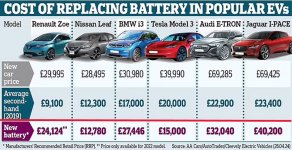
Selling prices for used EVs are dropping into the crapper

Few of them showing as worth now and cost to replace the batteries
Damn, look at the costs to replace for a Jag :(

crapperevs.jpg

Also, new chargers people are buying are failing as soon as only 1 week of use
Many are requiring an electric source of 240 volts at 50 AMPs and where they live do not have the capability of adding that load to the main fuse panels :-(
 
Top