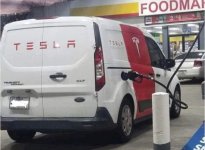
Are we still convinced that electric vehicles are the best way forward?

Roscobbc

Moderator
Americans will be forced to pay more for an inferior product they clearly do not want.
As will the British - did anyone see the Channel 5 TV show tonight (at 8.00pm)

Petrol vs Electric Cars: Which is Better?​

Total one-sided show about how cheap electric cars are to run and their superior performance (comparing two top-end Mercs, one a £90K C 63 and the other an electric equivalent - presumably a £150K EQS580) - got to watch for the obvious omissions! - was this show funded by the motor industry or HMG?
 

CaptainK

Administrator
I didn't watch it, but heard about it. You just knew anything that was going to be on TV would be completely biased. TV presenters and so forth need funding, and bad mouthing the government and car producers with the truth about anything is just gonna get their funding reduced / removed. So just tag the company line.
 

Mad4slalom

Well-known user
As will the British - did anyone see the Channel 5 TV show tonight (at 8.00pm)

Petrol vs Electric Cars: Which is Better?​

Total one-sided show about how cheap electric cars are to run and their superior performance (comparing two top-end Mercs, one a £90K C 63 and the other an electric equivalent - presumably a £150K EQS580) - got to watch for the obvious omissions! - was this show funded by the motor industry or HMG?
As soon as I saw the title I suspected it may be a bit biased. Just like any vehicle fire isnt mentioned when an ev involved but widely reported if an ice .
 

Vetman

CCCUK Member
As will the British - did anyone see the Channel 5 TV show tonight (at 8.00pm)

Petrol vs Electric Cars: Which is Better?​

Total one-sided show about how cheap electric cars are to run and their superior performance (comparing two top-end Mercs, one a £90K C 63 and the other an electric equivalent - presumably a £150K EQS580) - got to watch for the obvious omissions! - was this show funded by the motor industry or HMG?
In addition, no mention of high repair cost, high insurance costs, and they thought the very high depreciation in value was a plus for someone buying a second hand EV.
 

teamzr1

Supporting vendor
For EV drivers traversing the great state of Wyoming, the Smith’s grocery store in Rock Springs is an oasis. It’s just off Interstate 80, there’s a Petco across the street, and it has six plugs promising to charge at 350 kilowatts.
At that rate, a Tesla Model 3 could go from empty to full in the time it takes to hit the bathroom and grab a Snickers.

But when I limped up to the station last month in a Rivian R1S crammed with one dog and two kids, that 350 kW may as well have been a mirage. Rivian’s SUV charges at 220 kW at best, and the charger itself crimped the hose to just 50 kW.

With one pit stop, our carefully planned seven-hour road trip got two hours longer.

This isn’t a Wyoming-specific problem, or a Rivian one. At U.S. public stations promising charging speeds of 100 kW or higher, the average delivered charge was only 52 kW in 2022, according to Stable Auto, which helps networks decide where to build new infrastructure. That disconnect - largely a reflection of battery power’s idiosyncrasies - is leaving many US drivers guessing as to when, why and by how much their charge is being throttled.

“The reality is we really don’t have a fast-charging infrastructure today,” says David Slutzky, chairman and founder of Fermata Energy, a startup that builds vehicle-to-grid charging systems. “They almost all ratchet down the charge pretty quickly.”

There are many good reasons why even the slickest public chargers rarely run at maximum capacity.
The chemical wizardry of battery power is more complex than pouring liquid in a tank, and both internal and external factors take a toll on charging speed.

For starters, an EV itself can only suck up electrons so quickly. Of the 55 electric models now available in the U.S., half charge above 200 kW and only five can charge at 350 kW. Those speeds are further compromised when it’s very hot or very cold. Temperature extremes can damage a lithium-ion battery, so automakers program their cars to slow a charge in certain temperatures.

Trickier still, EV charging slows naturally as the car’s battery approaches full, in order to keep it from overheating. (Smartphones and laptops do the same thing.) The specifics of this charging curve are unique to each car, though brands are cagey about sharing those specifics, even with the people buying their products. Tesla vehicles, for one, have relatively steep charging curves, meaning the “fast” part of the charging doesn’t last long.

Finally, charging networks themselves crimp electron flow.
On a hot day, the local grid might be maxed out by thirsty air conditioners, or the plugs’ hoses may be close to overheating. Many stations split power between cars, allowing them to install more cords with the same electricity. In other words, a 200 kW charger becomes a 100 kW charger when someone uses its second cord. (The U.S. Department of Energy classifies plugs 50 kW and up as “fast.”)

“There’s sort of this complicated handshake between the vehicle and the charger, so I think there’s an education gap for sure,” says Sara Rafalson, executive director of policy at EVgo.

That gap risks hurting EV adoption in the U.S., where charging speed has become a marketing metric. Automakers like to trumpet how quickly their cars can go from 10% or 20% full to 80%, while public charging stations tend to display maximum charge rate — not average or expected — right on the machines. Some 17% of U.S. public chargers are rated 100 kW-plus, according to BloombergNEF, compared with only 10% in the UK and 2% in the Netherlands.

“We still see a lot of discrepancies between what the customer is expecting and what they’re seeing at the site,” says Anthony Lambkin, vice president of operations at Electrify America, which operates almost 1,000 U.S. stations.
“The great news is we have a lot of new drivers, and this is just one of those learning-curve things.”

Consumers are a little less sanguine. One snapshot of 103,000 Tesla charging sessions found average charging speeds of only 90 kW less than half of the maximum, according to Recurrent Auto, a startup that tracks battery health.
And in a recent JD Power survey, EV owners scored public charging speeds near the bottom of 10 categories studied. Brent Gruber, executive director of JD Power’s EV practice, says consumers develop false expectations “when you plaster those [kilowatt] numbers on the charger itself.”

Charging executives concede that they could do more to educate consumers, particularly those new to electric cars. “That is still a challenge,” Lambkin says. “But there’s a real tech aspect to this that seems to draw people in. People get very, very excited when they see that they’re getting their maximum charge rate.”

Charging’s inherent complexity means the speed gap will never close entirely, but it should narrow in the near future. Charging networks are building faster and larger stations in the U.S., which will ease the need for power dilution across plugs. Since the end of 2022, every station built by Electrify America has been capable of 350 kW, and a couple of its sites now have 20 charging slots.

Carmakers have also realized that max charging rate is a deciding factor for car buyers, and are dialing it up on coming models.
“There will be a catch-up on the technology side that should meet that catch-up on the learning-curve side,” Lambkin says.

But for the time being, the best way to cope with the unpredictability is to prepare for it, sometimes doggedly. Before Jacob Espinoza sets off on any road trip from his home in New Mexico, he goes through a three-part checklist:
Plug his destination into a route-planning app; check the charging network apps; and check Plugshare, a platform for crowdsourced charger reviews.

“When you do those three things, it’s really not that hard to take long trips in an EV,” says Espinoza, who chronicles his battery-powered road trips on YouTube.

Back in Rock Springs, I was paying the price for having skipped Espinoza’s steps two and three. After about 15 minutes of 50 kW charging, we cut our losses and drove another 100 miles north to Pinedale, Wyoming, where two cords idled in a dusty lot behind Stockman’s Saloon and Steakhouse. The “Frontier Days” festival was in town, so we wandered by to catch a folk concert.

With a maximum charging speed of 120 kW, the Pinedale plug should have been far slower than our 350 kW machine in Rock Springs. But we only had 90 miles to go, and it covered that in just a few minutes. Frontier days, indeed.
 

Roscobbc

Moderator
Guessing here in the UK with average mileage and really long journeys perhaps significantly less than in the USA we'll see a scaled down version of those charge rate limitations.......however the real worry for many early adopters of electric vehicles (given the government 'incentives' they were give to buy an electric vehicle) is the looming threat of 'pay per mile' charges, initially to 'claw back' some of HMG's losses from the 'early' electric car adopters who would have avoided annual road tax and fuel duty. Wonder when the government will try to increase home charging costs......?
The new Labour government are alienating many sections of society after only a few months in power........
 
Last edited:

teamzr1

Supporting vendor
The Italian government led by Prime Minister Giorgia Meloni walks a fine line between Globalism and its conservative DNA.
But now and then the Italians break rank with the wider European thought to take a more principled stand, as it appear to be the vase now.
It arises that Italy has now called for a review of the European Union’s 2035 petrol car ban, amid fears it risked triggering the industry’s ‘collapse’.
This comes as it appears the EV fad has faded, and buyers are starting to reject electric vehicles ‘en masse’.

Telegraph reported:

“Ministers from Giorgia Meloni’s government claimed the “absurd” policy was ideologically driven and required change to reflect the realities of the market. There has been growing unease across the Continent about a slowdown in demand for electric vehicles (EVs).”

Besides this trend, there’s also widespread concern that Europe’s car industry may be falling behind manufacturers in China and the US.
Just last week, industry leader Volkswagen warned it may close factories in Germany for the first time.
The car giant suffers from high energy prices.

This has led many to call for ‘a rethink’ of EU ‘green’ climate goals, which ended up enacting a ban on internal combustion engine cars by 2035.

“Gilberto Pichetto Fratin, the Italian energy minister, told Bloomberg: ‘The ban must be changed’.
Adolfo Urso, the industry minister, added: ‘In an uncertain landscape, which is affecting the German automotive industry, clarity is needed to not let the European industry collapse. Europe needs a pragmatic vision, the ideological vision has failed. We need to acknowledge that’.”


Urso has called for the conversion targets to be reviewed early by the European Commission.
All the while, Italy is saying that it is not opposed to EVs, but the country argues that the ‘transition to clean energy’ should also involve other technologies.

“Meanwhile, Volkswagen – Germany’s largest industrial employer and Europe’s top carmaker by revenue, has been hammered by rising power prices after the loss of cheap Russian gas in the wake of the invasion of Ukraine. The company has also been struggling with its push into electric cars.

Sales of EVs stalled in the first half of the year, and the company delayed the US launch of its latest electric sedans indefinitely.”

This all happens in the context of a worsening outlook for Germany’s economy, with its manufacturing sector suffering greatly.
 

phild

CCCUK Member
Can you really see Starmer and his mob ever seeing sense?

Sense, common or not, is an attribute rarely seen in politicians these days in any party, Starmers lot seem to be particularly lacking. :rolleyes:
There does seem to be increasing investment in hydrogen technology both for fuel cells and conversion of existing ICE vehicles. Seems a far more sensible solution than scrapping perfectly good vehicles. We shall just have to wait and see.
 

teamzr1

Supporting vendor
California firefighters had to douse a flaming battery in a EV Tesla Semi with about 50,000 gallons of water to extinguish flames after a crash, the National Transportation Safety Board said Thursday.

In addition to the huge amount of water, firefighters used an aircraft to drop fire retardant on the “immediate area” of the electric truck as a precautionary measure, the agency said in a preliminary report.

Firefighters said previously that the battery reached temperatures of 1,000 degrees Fahrenheit while it was in flames.

The NTSB sent investigators to the Aug. 19 crash along Interstate 80 near Emigrant Gap, about 70 miles northeast of Sacramento. The agency said it would look into fire risks posed by the truck's large lithium-ion battery.

The agency also found that the truck was not operating on one of Tesla's partially automated driving systems at the time of the crash, the report said. The systems weren't operational and “could not be engaged,” according to the agency.

The crash happened about 3:13 a.m. as the tractor-trailer was being driven by a Tesla employee from Livermore, California, to a Tesla facility in Sparks, Nevada. The Semi left the road while going around a curve to the right and hit a tree, the report said. It went down a slope and came to rest against several trees. The driver was not hurt.

After the crash, the Semi's lithium-ion battery ignited. Firefighters used water to put out flames and keep the batteries cool. The freeway was closed for about 15 hours as firefighters made sure the batteries were cool enough to recover the truck.

Authorities took the truck to an open-air facility and monitored it for 24 hours. The battery did not reignite.
The NTSB said all aspects of the crash are under investigation as it determines the cause. The agency said it intends to issue safety recommendations to prevent similar incidents.

A message was left Thursday seeking comment from Tesla, which is based in Austin, Texas.
After an investigation that ended in 2021, the NTSB determined that high-voltage electric vehicle battery fires pose risks to first responders and that guidelines from manufacturers about how to deal with them were inadequate.
 

teamzr1

Supporting vendor
President-elect Donald Trump’s transition team is planning to kill the $7,500 consumer tax credit for electric-vehicle purchases as part of broader tax-reform legislation, two sources with direct knowledge of the matter told Reuters.
Ending the tax credit could have grave implications for an already stalling U.S. EV transition.

And yet representatives of Tesla by far the nation’s largest EV seller have told a Trump-transition committee they support ending the subsidy, said the two sources, who spoke on condition of anonymity.
Recall that Joe Biden’s “Inflation Reduction Act” which was really the Green New Deal gave a tax credit up to $7,5000 for people who purchased new electric vehicles through 2032.
Under Biden’s plan, if you bought an electric vehicle averaging $62,893, you might have been eligible for a tax credit of up to $7,500 until the year 2032.

$62,893 is the average price of vehicles sold only through dealerships and does not account for direct-to-consumer sales of more expensive electric vehicles. This number also accounts for all-electric vehicle transactions, both new and used.
The Biden Regime and the Democrats in Congress wasted billions of dollars on the electric vehicle scam.

In 2021, the Democrat-controlled Congress gave Joe Biden $7.5 billion to install electric vehicle chargers all over the country and
only 7 or 8 EV charging stations have been built.
It’s a total scam.

According to a 2021 analysis from the New York Times, $1.2 trillion of the ‘Infrastructure’ bill would be spent over 8 years and $550 billion will go to roads, bridges, rail lines, electric vehicles, water systems and other programs.

Electric vehicles are unpopular, expensive and bad for the environment, but the Biden Regime is going into overdrive to force car companies to produce more EVs while they crack down on gas-powered vehicle tailpipe emissions.
 

Chuffer

CCCUK Member
Here in the UK sales of new EV`s are dropping off a cliff with some manufacturers stalling production as they cannot meet their sales targets . This situation will only get worse for them soon ( better in my opinion ) as our new Labour Government has announced the removal of massive Vehicle Excise Duties incentives introduced some years ago during the 14 year Conservative Governments previous tenure in power . Very soon EV drivers will have to pay to use our roads like the rest of us .
In the meantime I happily use my Jeep Grand Cherokee 5.7 Hemi V8 as a daily driver with a smug feeling of satisfaction that it has well and truly `wiped it`s face ` on Carbon Footprint . It is 18 years old and only it`s second owner and have every annual MOT Certificate from new which it has never failed although a couple of " advisories to fix " in the earlier years . During the years I have owned and self maintained the vehicle it passes the MOT test with no advisories every year and the emissions tests continue to be "as clean as they could be" according to the guys at my local testing station . Apart from replacing seized front brake calipers it has only cost me routine maintenance so I am well pleased . 😇
 

phild

CCCUK Member
Here in the UK sales of new EV`s are dropping off a cliff with some manufacturers stalling production as they cannot meet their sales targets . This situation will only get worse for them soon ( better in my opinion ) as our new Labour Government has announced the removal of massive Vehicle Excise Duties incentives introduced some years ago during the 14 year Conservative Governments previous tenure in power . Very soon EV drivers will have to pay to use our roads like the rest of us .
In the meantime I happily use my Jeep Grand Cherokee 5.7 Hemi V8 as a daily driver with a smug feeling of satisfaction that it has well and truly `wiped it`s face ` on Carbon Footprint . It is 18 years old and only it`s second owner and have every annual MOT Certificate from new which it has never failed although a couple of " advisories to fix " in the earlier years . During the years I have owned and self maintained the vehicle it passes the MOT test with no advisories every year and the emissions tests continue to be "as clean as they could be" according to the guys at my local testing station . Apart from replacing seized front brake calipers it has only cost me routine maintenance so I am well pleased . 😇


There seems to be an upsurge in the adoption of hydrogen technology which will quell the range anxiety from EV's. There is also the ability to convert regular ICE engines to run on hydrogen, a latter day LPG thing. Seems very sensible rather than scrapping perfectly useable vehicles which I'm not sure is a good thing for carbon footprints.
 

Chuffer

CCCUK Member
There seems to be an upsurge in the adoption of hydrogen technology which will quell the range anxiety from EV's. There is also the ability to convert regular ICE engines to run on hydrogen, a latter day LPG thing. Seems very sensible rather than scrapping perfectly useable vehicles which I'm not sure is a good thing for carbon footprints.
Totally agree . Just think of all the infra -structure costs it will save compared to covering the country with EV charging points and its associated carbon footprint in manufacturing of miles and miles of cables .
 

teamzr1

Supporting vendor
Head of GM Barra 2 weeks ago dumped a lot of her GM stock she got for free and profited by $85 million bucks so
she knows what is coming and at the same time is firing lots of the GM workers and will get worse next year as to President Trump
is going to kill off the EV mandate

General Motors Co. on Friday again laid off roughly 1,000 people globally, with a majority working out of the automaker's Global Technical Center in Warren, according to a person familiar with the matter.

The layoffs, which were done as part of a reorganizing effort, affect both salary and hourly GM employees and impact multiple departments.

The affected employees will receive a payment equal to their wages and benefits only through Jan. 14, 2025, according to a Worker Adjustment and Retraining Notification filed with the state.

In total, 507 employees working at the Global Technical Center or assigned to work there were let go, according to the notice. The cuts included 34 employees working in after sales engineering, 40 working in engineering operations, 26 in manufacturing engineering and 24 in sales operations.

“In order to win in this competitive market, we need to optimize for speed and excellence," GM spokesperson Kevin Kelly said in a statement. "This includes operating with efficiency, ensuring we have the right team structure, and focusing on our top priorities as a business. As part of this continuous effort, we’ve made a small number of team reductions.

We are grateful to those who helped establish a strong foundation that positions GM to lead in the industry moving forward.”

These layoffs come after GM in August laid off more than 1,000 salaried employees working in its software and services organization.
 

teamzr1

Supporting vendor
Rental car giant Hertz is dramatically expanding its electric vehicle selloff program, with used Tesla Model 3s now available for under $20,000 as the company grapples with mounting EV depreciation costs.
Hertz’s heavy investment in Tesla EVs has been a disaster, causing massive losses and the loss of its CEO.

Inside EVs reports that Hertz’s ambitious electric vehicle program has hit another significant roadblock, with the company reporting an 89 percent increase in EV depreciation costs, amounting to $537 per vehicle per month.
The rental car company has committed to selling 30,000 electric vehicles from its fleet by the end of 2024, marking a stark reversal from its earlier EV adoption strategy.

The company’s current predicament stems from its bold 2021 initiative to “go green,” which included plans to purchase 100,000 Tesla Model 3s. While this initial vision appeared promising, with benefits including reduced maintenance costs and strong customer interest, the strategy has since encountered numerous challenges that have forced a significant course correction.

A primary factor in Hertz’s EV difficulties has been Tesla’s multiple price reductions, which have severely impacted the residual value of the rental fleet. These price cuts have created a ripple effect throughout the used EV market, leading to accelerated depreciation of Hertz’s electric vehicle assets. The company is now offering used Tesla Model 3s at prices below $20,000, with additional savings possible through the $4,000 federal tax credit available for used EVs.

The financial impact has been substantial. Beyond the depreciation costs, Hertz has discovered that its Tesla fleet hasn’t delivered the anticipated cost savings. Repair expenses have exceeded expectations, and the company has experienced higher-than-anticipated collision rates with its Tesla vehicles, resulting in significant restoration costs and extended repair times.

These compounding factors have contributed to multiple quarters of losses, resulting in the resignation of CEO Stephen Scherr earlier this year.
 

Roscobbc

Moderator
And there lies the story of individuals and businesses 'listening' and believing what our politicians who rule over us and enforce upon us.......albeit for a few short years whilst their party is in power.
Much the same here in UK where, no doubt as with the 'States major decisions are being made for us by people who have zero knowledge or understanding about the issue they are ruling on, and simply 'spouting-off' Parrott fashion as informed by supposedly knowledgeable 'Advisors' and industry 'experts'.
 

teamzr1

Supporting vendor
Lotus has reversed its all-electric strategy, opting instead to develop hybrid powertrains for its future lineup.

The Chinese-owned, historically British manufacturer had previously announced in 2021 that the Emira would be its last internal combustion engine model, with the brand planning to transition entirely to EVs by 2028.

Now, Lotus CEO Feng Qingfeng says the brand will pursue "super hybrid" technology to meet customer demand, especially in key markets like China and Europe.

The new hybrid system will combine a turbocharged gasoline engine with a high-voltage battery pack, promising a total range of 680 miles. According to Autocar, Feng emphasized Lotus's adaptable approach: “At Lotus, we have always chosen the best power technology available, whether it’s pure gasoline, pure electric, hybrid or range-extended [EV].”

Unlike traditional plug-in hybrids, which can feel underwhelming once the battery drains, Lotus's hybrid architecture aims to eliminate this drawback with a 900V system capable of ultra-fast charging reportedly faster than battery-swapping.

While specific models equipped with the hybrid tech remain unconfirmed, refreshed versions of the Eletre SUV and Emeya sedan seem likely candidates. The additional versatility of a hybrid setup could attract a broader buyer base, additionally, Lotus would enjoy lower tariffs on vehicles shipped into the European Union, which exempts PHEVs from additional duties imposed on Chinese-built EVs.

However, fans of Lotus's lightweight sports cars shouldn’t hold their breath, as the hybrid platform appears tailored for larger, heavier vehicles. For enthusiasts, the Emira remains a "traditional" Lotus offering for a few more years, standing as the brand’s last purely internal combustion sports car.
 
Top