Engine Scavenging
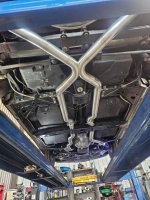
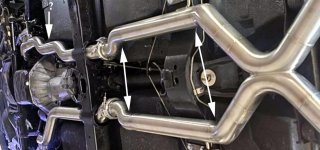
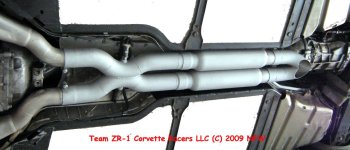
The vacuum created by the flow of exhaust through the exhaust manifold. When a system is tuned properly, engine scavenging can greatly increase efficiency and horsepower because it helps pull exhaust out of the other cylinders.
Pipe Sizes
Size does matter when you're deciding which performance exhaust system is right for your vehicle.
If the pipe is too narrow, it creates a lot of restriction that robs you of horsepower, torque and fuel economy.
On the other hand, piping that is too large for your motor will hamper engine scavenging, which will also slow you down.
The biggest misconception about performance exhaust systems may be that they are extremely difficult to install, but nothing could be farther from the truth. You don't need a degree in welding to bolt these systems onto your rig. In fact, you don't even need a soldering gun.
Your performance exhaust will arrive in multiple sections that, once fitted together, form your complete system. The pipes are slightly tapered at the end, which allows you to just slide the different pieces together.
To prevent any exhaust from leaking out of these joints, your kit will include easy-to-use pipe clamps that fuse the sections. After you finish assembling the exhaust system, all you have to do is swap out the old pipes with the new ones.
In most cars, trucks and SUVs, the factory-installed pipes will have to be cut away from the catalytic converter using a reciprocating saw or hacksaw.
Once the old pipes are off and in the garbage, your new performance tubes are ready to move in. Luckily, our performance exhaust systems use factory-style hanging hardware, so you won't have to modify your undercarriage to install your new pipes.
Engines need a certain amount of back pressure to run correctly.
Although the statement about not running too large of a tube is correct.
An engine needs the correct back pressure to produce the maximum power by keeping pumping losses low.
Too big of an exhaust pipe causes power loss, especially in low-end torque, because a big pipe has less exhaust stream velocity than a smaller pipe.
Velocity is essential to get the best scavenging effect from tuned headers.
In simple terms, if the exhaust gas flow is kept high with good velocity, a vacuum can develop behind the closed exhaust valve allowing even better scavenging when the exhaust valve opens on the next exhaust cycle.
Good scavenging is even more critical on valve overlap, the part of the four-stroke cycle where both the intake and exhaust valves are open.
If the exhaust pipe is too large, the flow will be sluggish with low velocity and the scavenging will not be as good.
Remember that a good exhaust has low back pressure and high velocity. The only possible exceptions to this rule are for turbocharged or nitrous engines.
It is almost impossible to put too big of an exhaust past a turbocharger as a turbo's efficiency depends a lot on the pressure differential across its turbine.
A turbocharged engine can have an exhaust gas volume of about 1.5 to 2 times more than an equivalent displacement, naturally aspirated engine. Engines using nitrous oxide also have a pretty high exhaust volume and require a bigger exhaust if they are to be optimized for nitrous operation



 ) Dougs have been mentioned.