E5 or E10 fuel any preference and additive addition?

purple charlie

CCCUK Member
probably been asked before but ... the C4 is my 3rd American but last Trans Am was over 20 years ago
5.7tpi should I be using E5 or E10 fuel? previously unleaded or leaded were the options.
further to this, would it need any fuel additive?

my background is in bikes and have been though the ethanol debate before on them.
 

teamzr1

Supporting vendor
GM did NOT even use fuel system parts that would live with Ethanol until around mid 2010
so the older the vehicle is the more apt that Ethanol will degrade parts like inside fuel tank to fuel injectors

Do not use E10 at all and your stuck using E5 and use products to keep fuel system clean
Your lucky only that in the USA they force E10 and E15 on us ( I only use non Ethanol gas in my C5)

The higher the Ethanol percent is,
the leaner the AFR will be and induce more engine knock and misfires with less fuel mileage
 

teamzr1

Supporting vendor
Your Welcome Charlie

You might want to get yourself a OBD1 scanner that also records your test drives
That way you can see if and how much leaner the engine is running when using E5 or E10
If too lean than cylinder temps are hotter and engine might have knock, could try 1 step colder sparkplug
with a bit shorter gap

Best case long term, is I tune for customers the engine controller (ECM) and make tune adjustments
to be able to handle Ethanol better allowing engine to run and perform better
 

Roscobbc

Moderator
Long gone are the days when you could source premium Super Unleaded without even a minimal amount of Ethanol - Shell V Power was marketed for a couple of years as Ethanol free (and then Ethanol was added). There are significant regional variations with all petroleum suppliers in terms of actual Ethanol content.......Tesco Super Unleaded has perhaps the highest octane rating for Super Unleaded with the lowest Ethanol content of all suppliers......even sometimes 0% in certain areas......but this can vary frequently.
 

teamzr1

Supporting vendor
GM has been sued multi times for damage done to the fuel systems and GM refusing to honor their own warranty when that damage was done and :

Legislation (HR 704) has been introduced in the U.S. House of Representatives to prohibit the sale of E15 (gasoline that is 15% ethanol) and eliminate the federal Renewable Fuel Standard's (RFS) mandate that 15 billion gallons of corn-based ethanol be blended into the U.S. fuel supply each year.

The EPA has turned to sales of E15 to achieve the law's artificial mandate.
Ethanol, especially in higher concentrations such as E15, will cause damage to older vehicles.

Please Contact Your Member of Congress to Request Support for HR 704

Ethanol can cause metal corrosion and dissolve certain plastics and rubbers, especially in older vehicles that were not constructed with ethanol-compatible materials.

• HR 704 would eliminate the unrealistic mandates imposed under the RFS such as requiring refiners to blend 36 billion gallons of biofuels by 2022.

• HR 704 would prohibit the sale of E15 gas in order to help meet the artificial RFS deadlines.

• HR 704 would protect older vehicles from the risks posed by E15.

DON'T DELAY!
Please contact your Member of Congress in Washington, DC immediately to request their support for RFS reform.
 

teamzr1

Supporting vendor
The law requires refiners to cap their blending of corn ethanol and use more cellulosic biofuels.
Never mind that very little cellulosic biofuel has ever been produced—even according to EPA’s own data.
But that fact hasn’t prevented the EPA from levying millions of dollars in fines against refiners for failing to use the phantom fuel.

It’s kind of like receiving a bill for something you cannot buy because it doesn’t exist, but you’re being charged anyway.

Then there is the “blend wall” problem.
With less gasoline sold than Congress anticipated, refiners cannot add ever-rising amounts of ethanol to gasoline without exceeding E10—the fuel consisting of 10 percent ethanol and 90 percent gasoline sold virtually everywhere in the country today.

To get around the blend wall issue, the EPA granted a “partial waiver” allowing the sale of E15, a fuel blend containing up to 15 percent ethanol for model-year 2001 and newer vehicles.

The EPA’s quick fix made a bad situation much worse. Ethanol levels higher than 8 percent can damage or destroy vehicle engines, according to a study conducted by the well-respected Coordinating Research Council.

Automakers are voiding warranties and refusing to be held responsible for mechanical problems caused by fuels containing more than 8 percent ethanol.

Ethanol contains less energy than gasoline, forcing motorists to fill up more often, thereby causing more consumer expenditures.
Ethanol production has driven up food prices here and abroad. Additionally, some studies indicate ethanol usage increases greenhouse-gas emissions.

Then politics entered the scene. Rumors flew that the EPA delayed the announcement of the 2014 blend levels to help Rep. Bruce Braley (IA-D) in his Senate bid. Braley pushed for an increase in the proposed levels and hoped to influence the White House to raise the targets.

Politico quoted Braley saying: “Voters in Iowa look at where I stand on this issue and where my opponent stands, who’s supporting me in this campaign and who’s supporting [Ernst].”
The Politico story states:
“Iowans say wavering on corn ethanol once would have been certain political suicide in a state where 90 percent of the land is farm acreage.
So Braley sought to capitalize on Ernst’s expressed qualms about big government, portraying her as someone Iowans can’t trust to fight for them.” Yet, Ernst, a Republican, won the Senate seat formerly held by Democrat Tom Harkin.

The EPA’s unwillingness to do its job by setting ethanol volumes—along with ethanol’s loss of “political heft”— should provide the impetus for ending the complex and wasteful RFS program.

Ethanol plays as a rare topic where environmentalists and energy advocates agree. As soon as the new Congress convenes in January, it should give the RFS an “F,” and reform, revise, or repeal it.

 

teamzr1

Supporting vendor
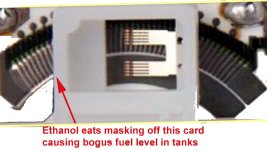
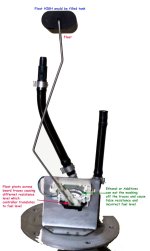
Countless C5s and C6s suffer with damage to the fuel sender and float where the damage causes incorrect reporting of the amount of gas in the tank or worse quit working
C5s alone GM has had to require TSB software updates to the PCM to try and solve the problem that did not prevent the effects of Ethanol eating fuel system parts so the claim GM in the 1980s designed fuel system parts for Ethanol is not correct
They were not designing parts back than for Ethanol percentage up to E15

floatcard.jpgFloat.jpg
 

Roscobbc

Moderator
Both Ethanol and Methanol have similar characteristics - the most important one that can effect the use of Ethanol in your tank is - (and in the same way that mineral brake fluid is hygroscopic), absorption of moisture from the surrounding atmosphere, and which given certain conditions and age etc can degrade some components (just like brake fluid) when your car is stored in cold, damp unventilated conditions.
OK, so the E5 and E10 fuel we are using have relatively small amounts of Ethanol (5% or 10% per litre/gallon) whereas the Methanol typically used for some drag racing and other motor sport is effectively use 'neat' which greatly magnifies the water absorption.......and the reason why racers religiously drain-off all the fuel after a race meeting.
 

purple charlie

CCCUK Member
an old friend, a biker, had a small Rotax powered mono plane. He came into the unit one day and showed us his fuel pipe.
there was a long green shoot growing in it around 10 inches long.
He was worried, he only taxies his plane now due to age, but if that had broken loose and blocked his carbs, the plane could have fallen out of the sky.

recently I have had a few bikes in, R1, R6, Z750, FXDCi, GSF1200 and more all with rusting fuel sender , pump and taps. Yet a couple of old BSA's not run since the 1970's, imports from America, where the carbs have been good apart from sediment.
the reason for asking about cars specifically.
 

Roscobbc

Moderator
Do an associated search on Youtube and you'll find a couple (perhaps more) of UK based petrol 'nerds' who visit (local to them) gas stations and buy fuel of various grades and do tests for Ethanol content of fuel. Some interesting and perhaps surprising results are reported.
 

Chuffer

CCCUK Member
I use Tesco Momentum 99 RON in my 1980 C3 when ever possible , but still add Lucas Safeguard Ethanol Conditioner at each fill up as a belt and braces measure . Plus Tesco prices are cheaper than the usual culprits and you get points on your Tesco Club Card . When I filled up a week ago , Tesco Momentum 99 RON was only 1p per litre more expensive than the robbing bastards at my nearest Shell station charge for the bog standard 95 RON fuel !!
Interesting to read that GM were ahead of the game for ethanol content way back in 1980 .
 
Top