Are we still convinced that electric vehicles are the best way forward?

Roscobbc

Moderator
Totally agree with you Roscobbc and Antijam , there is a lot to be said for dictatorships . Amongst the many failings of politicians is not learing from history and just thrive on their own egos and agendas .
Chuffers comment........"there is a lot to be said for dictatorships"........
The two quasi-dictatorships that come to mind recently are Boris and Trump........both indiviuals did some good in their 'reign'............but, equally both also cocked-up big time and alienated many people...........
 

Chuffer

CCCUK Member
Chuffers comment........"there is a lot to be said for dictatorships"........
The two quasi-dictatorships that come to mind recently are Boris and Trump........both indiviuals did some good in their 'reign'............but, equally both also cocked-up big time and alienated many people...........
Just like dear old Ollie Cromwell , he had the right ideas to start with but then became as un popular as Charles 1st . and had to be got rid of . What goes around comes around and there is nothing new under the sun .
 

antijam

CCCUK Member
The obvious downside of even 'benevolent' dictatorships lies in the quote by the historian Lord Acton - "Power tends to corrupt, absolute power corrupts absolutely".
This is demonstrably true of almost all dictators in history - including Boris Johnson and Donald Trump. Sometimes you have to live with the 'bad' to get the 'good'.
 

Chuffer

CCCUK Member
The obvious downside of even 'benevolent' dictatorships lies in the quote by the historian Lord Acton - "Power tends to corrupt, absolute power corrupts absolutely".
This is demonstrably true of almost all dictators in history - including Boris Johnson and Donald Trump. Sometimes you have to live with the 'bad' to get the 'good'.
Come the Revolution everything will change . (y) :LOL:
 

teamzr1

Supporting vendor
1,500 of US workers are expected to be laid off when automaker Stellantis closes an assembly plant in northern Illinois early next year,
citing the challenge of HIGH rising costs of electric vehicle production.

The company, which employs about 1,450 workers at the plant in Belvidere, Illinois, said the action will result in indefinite layoffs, and it may not resume operations as it considers other options.

Stellantis said the industry 'has been adversely affected by a multitude of factors like the ongoing pandemic and the global microchip shortage, but the most impactful challenge is the increasing cost related to the electrification of the automotive market.'

The Belvidere plant, produces the Jeep Cherokee SUV, will be idle starting on February 28, 2023, Stellantis said.
The plant in Toluca, Mexico will now produce the vehicles.
 

Roscobbc

Moderator
1,500 of US workers are expected to be laid off when automaker Stellantis closes an assembly plant in northern Illinois early next year,
citing the challenge of HIGH rising costs of electric vehicle production.

The company, which employs about 1,450 workers at the plant in Belvidere, Illinois, said the action will result in indefinite layoffs, and it may not resume operations as it considers other options.

Stellantis said the industry 'has been adversely affected by a multitude of factors like the ongoing pandemic and the global microchip shortage, but the most impactful challenge is the increasing cost related to the electrification of the automotive market.'

The Belvidere plant, produces the Jeep Cherokee SUV, will be idle starting on February 28, 2023, Stellantis said.
The plant in Toluca, Mexico will now produce the vehicles.
Presumably far cheaper wage costs and overheads in Mexico...............?
 

teamzr1

Supporting vendor
It is now more than twice as expensive to charge an electric vehicle in Norway’s capital, Oslo, than to fill up a gas-powered vehicle.

It was reported in the local newspaper Avisa Oslo that the price of Oslo’s municipal electric car chargers rose dramatically after the city’s budget was approved last week.

As of 2019, the local government began charging citizens for charging their electric vehicles.
The prices ranged from 5 to 15 kroner per hour ($2) based on the charger’s output in kilowatts and the time of day, according to The Local.

The charges for the normal late-night and overnight charging have increased by seven times in less than four years.

Now, the Oslo government increased the charging of electric vehicles from NOK 28 to NOK 49 (USD 2.80-4.90) an hour for “normal” recharging during the day and NOK 13 to NOK 39 (USD 1.31-3.94) at night.

As a result of the price increase, Norsk elbilforening, the Norwegian Electric Vehicle Association, stated that it could no longer support the purchase of an electric vehicle, according to News in English.

In some cases, it can be twice as expensive to charge an electric car as to fill up with polluting (fossil) fuel,” Christina Bu, secretary general of the el-car organization, told newspaper Finansavisen.
She went on to call the rate hike that was imposed literally overnight by the Oslo city government (ironically led by the Greens and Labour parties) as “idiotic.”
Due to public outcry and massive pressure from the Electric Vehicle Association and local EV owners, the Oslo city council has voted to revise the cost of charging on municipal street charging.

“We have communicated how many members who depend on street charging have contacted member services in the Electric Vehicle Association and expressed despair at the price shock,” said Christina Bu.
“The city council acknowledged last week’s charging problem. They stood up for their own climate goals and met the electric drivers,” he continued.

The new prices still involve an increase from the original price, but the price increase is therefore markedly lower than what the city council decided on 7 December.
These are the prices that come into force over the New Year (the examples are for rate zone 3052 or 3054):

At charging stations where it now costs NOK 35 ($3.54) an hour at night, after the New Year it will cost NOK 19 ($1.92) per hour.
The old rate was NOK 13 ($1.31).

At charging stations where it now costs NOK 49 ($4.95) per hour during the day, after the New Year it will cost NOK 27 ($2.73) per hour.
The old rate was NOK 18 ($1.82).

The price shall enter into force “as soon as possible”. Aftenposten reports that it will be in the New Year.
The Electric Vehicle Association has requested that the prices take effect before Christmas.
 

CaptainK

Administrator
Talking of electric vehicles, I randomly found this thread where people are discussing converting their C3s to electric. One of them did it 10 odd years ago with lead acid batteries.

Electric C3

How shocked (pun intended) are you now at the thought of electric C3s? :eek: :ROFLMAO:
 

teamzr1

Supporting vendor
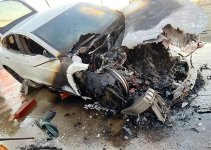
Firefighters used 6,000 gallons of water to extinguish a Tesla Model S that spontaneously burst into flames on a busy highway outside of Sacramento, Ca on Saturday.

The driver, who was not injured, was on Highway 50 in Rancho Cordova at around 3pm when smoke started to come out from the front of the car.
Photos of the luxury car showed the vehicle completely totaled, with the front end of completely burnt.

Officials responded to the scene with two fire engines and a water tender.
The Metro Fire of Sacramento crew said that nothing was previously wrong with the car.

flashfie.jpg
 

teamzr1

Supporting vendor
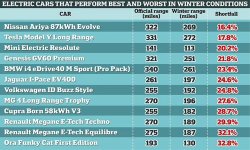
If you're thinking about buying an electric car, you need to know that they do not like Britain's icy winters and will not perform to the levels quoted by their manufacturers.

That's according to a new study published at a time when parts of the UK is experiencing plummeting temperatures and snowfall.
It found real-world ranges of popular electric vehicles (EVs) can fall by almost a third when it's particularly cold outside.

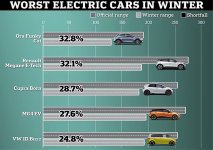
A review of 12 of the nation's best-selling battery-powered cars found that the worst was 32.8 per cent down on its claimed driving range on a full charge.
The least impressive performer among the selection of EVs was China's new Ora Funky Cat, which starts from £31,995 in the UK.

elecloss2.jpgelectloss.jpg
 

Roscobbc

Moderator
That Ora 'Funked-Up' Cat looks a dodgy choice - and there a quite a few other electric vehicles 'out there' and not mentioned on that list.
 

Mike-

Regular user
As an owner of an electric vehicle I feel qualified to answer the question posed in the thread title - no!

We’ve had a Mercedes EQC for just over a year and in fairness it’s really nice, quiet and refined, very cheap charging off-peak at home, fast at the bottom end, easy to drive, and so on.

I will however no longer take it on a journey that requires any sort of public charging. This is a company vehicle, my daily is a high miler BMW 530D, and obviously the Vette in the garage. My rates at home per kwh are 34p and 7.5p for four hours a night. To break even cost wise with my BMW it‘d be 40p. The new Octopus tariff in my area is moving to 42p shortly. We used to have a Ionity subscription which came with the car at 25p, which wasn’t too bad. This has now changed for 2023 to 53p, more expensive than the diesel. You struggle now to find any public chargers less than 60p and most are 80p and up, which is double the cost of taking the diesel and about the same as taking the Z06…

Anyway, the maths and cost is barely the point, it’s the time. We took a trip from Yorkshire to Southampton, 240 miles each way, with a free hotel charge at the other end. So in theory leave with a full charge, tickle it somewhere for 20 mins, plug in at the hotel and do the same on the repeat journey. Fine on the way down, but the hotel charger wasn’t working, or too busy, and too slow to even get a full charge overnight. On the way home at 8pm with a tired baby and -1 Celsius we stopped and required a full charge. This was at 83pkwh at a Shell garage, and totalled £95 to gain 200 miles AND TOOK OVER AN HOUR! All chargers in the area were this cost and speed. With the baby crying and while watching ICE cars waltz in and out and fuel up in ten seconds and be on their merry way, I‘ve never been so frustrated in a car. I’m still not over it which is why I‘m still moaning. If the charge was free it wouldn’t have been worth it, never mind the same as doing as 15 to the gallon.

Add into that most chargers being busy now, especially in peak times, the amount of time and money I’ve spent pointlessly at Services, the weird non queuing system these places have, downloading countless apps just to get a charge and filling in forms on my phone, we absolutely are not getting another EV. It’s good when we do short journeys and get the off peak rate, which will no doubt change, but also literally takes four nights to charge up. Get an EV if you go nowhere or hate yourself, basically.
 

Roscobbc

Moderator
Quite a damning comment from Mike-. I've noticed that over the last couple of years or so the used prices of earlier (and cheaper) production Tesla model S's that carry 'free' changing at Supercharger stations have increased significantly in price. Guessing that is due to the 'benefits' of a comprehensive charger network in many parts of the UK and the benefits of Tesla only charging. Wonder how Tesla's 'experiment' to open up a limited number of Supercharger stations to 'other' electric vehicles is going? - I would guess that Tesla owners would be very upset if their 'exclusivity' and perhaps minimal waiting to charge-up is jeopodised by queues of 'ordinary' electric vehicles ousting Tesla's at their own charging points.
TBH with the constantly reported shortages of on-street charging points I would be surprised if our HMG pressurised Tesla to 'open-up' Superchargers to 'all comers'.......
 

teamzr1

Supporting vendor
Germany forms alliance to change EU's planned combustion engine ban

The European Commission may table a legally-binding proposal in the coming weeks to make e-fuels exempt from the EU's planned ICE ban.

BERLIN -- Germany has formed an alliance with Italy and some Eastern European countries opposing the planned phase-out of internal combustion engines from 2035 unless cars running on e-fuels are exempted from the ban.

Transport ministers from Germany, Italy, the Czech Republic, Poland, Romania, Hungary and Slovakia met on Monday to discuss changes to the European Union plans.

German transport minister Volker Wissing said skepticism about phasing out internal combustion vehicles was shared by Italy, Poland and the Czech Republic, among others.
Berlin is in talks with Brussels and is seeking a resolution “as soon as possible” before it can sign off on any deal, Wissing told reporters on Monday in Strasbourg.

"The proposal needs changes urgently," Wissing said.
He said the group of countries wants a separate category of combustion-engine cars that could run on synthetic, carbon-neutral e-fuels, after 2035.
"A ban on the combustion engine, when it can run in a climate-neutral way, seems a wrong approach for us," Wissing said on Monday.

Volkswagen and Porsche are developing e-fuels and have argued they could be an alternative to electrification in some segments of the auto industry. Wissing said vehicles running on e-fuels only should be exempt from the planned ban.

"We do not want to stop things, nor do we want them to fail in the end," Wissing said. "We want the regulation to succeed — we need climate neutrality — but we have to remain technology-open, anything else is not a good option for Europe."

New proposal to come

Czech Transport Minister Martin Kupka said the European Commission may table a legally-binding proposal on e-fuels in the coming weeks.
"The information was that it will be in the next days or in the next two weeks to find a solution for this exemption for e-fuels," Kupka said. "It is necessary to find a solution.

The ICE ban, the EU's main tool to speed up Europe's shift to electric vehicles, was put on hold earlier this month after last-minute opposition from Germany. That surprised policymakers in Brussels and other member states because EU countries and the European Parliament had already agreed to a deal on the law last year.

The EU says the 2035 date is crucial because the average lifespan of new cars is 15 years – so a later ban would stop the EU reaching net zero emissions by 2050, the global milestone scientists say would avert disastrous climate change. Transport accounts for around a quarter of EU emissions.

But cars hold outsize importance in Germany, where the auto industry employs about 800,000 people and has revenue of about 411 billion euros ($441 billion), making it the largest segment of the economy by far.

Proponents of e-fuels say they are essentially renewable electricity that has been converted into a combustible, liquid fuel using CO2 captured from the atmosphere.
Critics say that e-fuels are a waste of renewable energy and should be saved for harder-to-decarbonize uses, while some parts of industry also worry that it could create regulatory uncertainty.
 

Roscobbc

Moderator
At last someone has 'stood-up' with some common sense. Perhaps when time gets closer to the planned ban on production of fossil fueled vehicles and there are far, far more electric vehicles in use someone, somewhere will come-up with factual figures relating to the 'real' emissions related to battery powered vehicles related to emission outputs from electrical generating stations and the mining of rare earth materials for battery production.
 

Mad4slalom

Well-known user
As an owner of an electric vehicle I feel qualified to answer the question posed in the thread title - no!

We’ve had a Mercedes EQC for just over a year and in fairness it’s really nice, quiet and refined, very cheap charging off-peak at home, fast at the bottom end, easy to drive, and so on.

I will however no longer take it on a journey that requires any sort of public charging. This is a company vehicle, my daily is a high miler BMW 530D, and obviously the Vette in the garage. My rates at home per kwh are 34p and 7.5p for four hours a night. To break even cost wise with my BMW it‘d be 40p. The new Octopus tariff in my area is moving to 42p shortly. We used to have a Ionity subscription which came with the car at 25p, which wasn’t too bad. This has now changed for 2023 to 53p, more expensive than the diesel. You struggle now to find any public chargers less than 60p and most are 80p and up, which is double the cost of taking the diesel and about the same as taking the Z06…

Anyway, the maths and cost is barely the point, it’s the time. We took a trip from Yorkshire to Southampton, 240 miles each way, with a free hotel charge at the other end. So in theory leave with a full charge, tickle it somewhere for 20 mins, plug in at the hotel and do the same on the repeat journey. Fine on the way down, but the hotel charger wasn’t working, or too busy, and too slow to even get a full charge overnight. On the way home at 8pm with a tired baby and -1 Celsius we stopped and required a full charge. This was at 83pkwh at a Shell garage, and totalled £95 to gain 200 miles AND TOOK OVER AN HOUR! All chargers in the area were this cost and speed. With the baby crying and while watching ICE cars waltz in and out and fuel up in ten seconds and be on their merry way, I‘ve never been so frustrated in a car. I’m still not over it which is why I‘m still moaning. If the charge was free it wouldn’t have been worth it, never mind the same as doing as 15 to the gallon.

Add into that most chargers being busy now, especially in peak times, the amount of time and money I’ve spent pointlessly at Services, the weird non queuing system these places have, downloading countless apps just to get a charge and filling in forms on my phone, we absolutely are not getting another EV. It’s good when we do short journeys and get the off peak rate, which will no doubt change, but also literally takes four nights to charge up. Get an EV if you go nowhere or hate yourself, basically.
sorry for your woes, this confirms to me that in theory ev’s are a great idea ,But also that we are being railroaded toward them prematurely before the cost, the range, the network and infrastructure as well as the issue of disposal of millions of worn out batteries have been properly thought out and addressed.
 

teamzr1

Supporting vendor
At last someone has 'stood-up' with some common sense. Perhaps when time gets closer to the planned ban on production of fossil fueled vehicles and there are far, far more electric vehicles in use someone, somewhere will come-up with factual figures relating to the 'real' emissions related to battery powered vehicles related to emission outputs from electrical generating stations and the mining of rare earth materials for battery production.

There have been 3 volcanos bust loose so far this year
They put out millions of tons of crap into the air and the waters and no one is trying to stop them :)

Corvettes starting with the C5s have 30 MPG when C3s were lucky I'd get 10 MPG, and they have less than
half the HP&TQ, so we cleaned up the air quite well while countries like China and India blow their crap all over the world

NASA has 4 spacecrafts that were launched in the 1970s and still have engine power to now, 2 of them are outside the Sun's reach
with power using heat from the decay of radioactive material, contained in a device called a radioisotope thermal generator (RTG).
The power output of the RTGs diminishes by only about four watts per year

So if governments would quit screwing around, we could do the same thing here on Earth

Voyagers 1 & 2 now are both slightly more than 11 billion miles (18 billion kilometers) from Earth

Launched in 1977, the twin Voyager probes are NASA’s longest-operating mission and the only spacecraft ever to explore interstellar space.
For two decades after launch, the spacecraft were planetary explorers, giving us up-close views of the gas giants Jupiter, Saturn, Uranus, and Neptune.
Now, as they reach distances far beyond the hopes of their original designers, the aging spacecraft challenge their team in new ways, requiring creative solutions to keep them operating and sending back science data from the space between the stars.

 
Last edited:

teamzr1

Supporting vendor
sorry for your woes, this confirms to me that in theory ev’s are a great idea ,But also that we are being railroaded toward them prematurely before the cost, the range, the network and infrastructure as well as the issue of disposal of millions of worn out batteries have been properly thought out and addressed.

They tried using battery power for vehicles back in the early 1900s,

The failed then and just as bad today, as those dictating what we can own and drive have bought hundreds of billions of stock shares in power plants using fossil fuels, so battery chargers can eat that up and shares in anything dealing with producing vehicles that still cannot maintain a battery for any real driving distances

Yet one of your so-called princes married to a woke commie comes to the USA and is burning up fuel to fly countless miles per year just to spew their horseshiff
 
Top