Recurrent misfiring problem

antijam

CCCUK Member
For more than a year now I’ve been experiencing an infrequent and so far undiagnosed, misfire. The engine is a 1971 stock (as far as I know) base 350/270 sbc of unknown mileage. It has points ignition, professionally rebuilt stock Quadrajet carb and headers. The car always fires up on the button and with everything on song, performs very well. Just occasionally it starts up with at least one cylinder misfiring or not firing at all. The first time this happened #5 was the culprit and after fiddling around with changed plug, HT lead and anything else I could think of, it seemed cured. A few weeks later it recurred, this time with #7 joining as a non-combatant. This immediately implied an electrical problem; not only are cylinders 5 and 7 adjacent on the engine, they’re adjacent in firing order. As well as verifying the resistance of the HT leads and plugs, I checked the obvious possibilities of cross firing between leads and tracking in the distributor cap but found nothing conclusive and sure enough the next time it was started, all cylinders were firing again. The misfire recurred infrequently over the next few months so in desperation I changed all the HT leads, the spark plugs, the coil, the distributor cap, points (though not the condenser) and rotor; one change at a time to see which, if any, had a curative effect – none did.

So, after the most recent recurrence, with my timing lamp showing both #5 and #7 not firing at all. I removed one plug at a time, rested it on the block with the HT lead connected and after fitting a spare plug in the vacated cylinder, fired it up. All plugs fired perfectly in fresh air. Even though they were firing in the open, perhaps I didn’t have a strong enough spark to always fire under compression, so I disconnected the plugs and connected an adjustable spark tester between the HT lead and earth. All leads produced a healthy spark at a 10mm gap, so the HT voltage should be more than adequate.

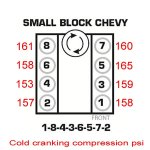
After this last testing, on firing up again with #5 and #7 still not firing, they were joined by an intermittent misfire on #3. Aha! 3,5 and 7 are all on the LH bank; perhaps I don’t have an electrical problem, perhaps I have a head gasket problem? I’ve done satisfactory compression tests on the engine in the past but I repeated it again today – results below. Compression still seems pretty much on point.
sbc comp.jpg

I’m running out of ideas now, with the only obvious possible problem left being fuel. If no fuel is getting to a cylinder, the spark plug would still fire so that’s not the problem. If too much fuel is getting there, it probably wouldn’t. The only thing I can think of that would cause unregulated fuel to enter cylinders on the same bank is if the intake manifold gasket was failing on that side, although why this would be intermittent I don’t know.:unsure: There’s no way to check this without removing the manifold, so before I start draining coolant and removing the distributor, carb and vacuum lines, does anyone have any other logical suggestions for causes of my problem?
 

Roscobbc

Moderator
Have you tried spraying some form of liquid all around the carb and inlet manifold to see if it gets drawn in the the engine, indicating a vacuum leak?
All V8 engines from the period with old school carburetion will experience often significant variations in the amount of intake charge received.....and there are specific cylinders on a SBC engine that suffer accordingly.
 

antijam

CCCUK Member
No, I haven't tried this yet Rosco. While an intake leak could certainly weaken the mixture to the point where the charge would fail to ignite - a misfire - I'm not sure why the plug would fail to fire, which my timing lamp is showing what's happening? Still, worth trying before I strip down the manifold.
 

Roscobbc

Moderator
I had exactly the same issue with my 427 engine. This took me about 9 months to find. It was not long after I'd installed an MSD ignition system and quality 8mm plug leads. It would idle fine. It would cruise fine. Holly DP I'd installed was fine and jetted correctly. It was an irritating misfire on to 7 cylinders on low end acceleration.......and most likely higher end too. Like you I tried everything and checked everything out....all to no avail. For some reason I (don't remember why) I removed the hood and unconnected to the issue chose to drive around the block in the evening.......the root cause was instantly visible at night. This was only under a driven load - didn't do it just revving when stationary. On the BBC engine one of the spark plugs was quite close to the header flange.....close enough to burn unseen through the underside of a spark plug boot. On idle and cruise with minimal load on the engine......no issue. Accelerate and the increased demand with the accelerator pump assisted rich mixture was enough for the spark to jump from the underside of the spark plug boot to the header flange..... effectively 'robbing' that particular cylinder of most of its spark as it 'jumped' to earth on the header flange. Basic electrical characteristics will always see an electrical current take the easiest path. Add a MSD ignition to an engine with it 5 fold (or whatever it is over stock) and the increased increased electrical energy is fully capable of jumping a 1/2" gap (which is what it was doing from the underside of the burn damaged plug boot. On idle and minimal demand cruise both the plug and the earth to flange 'jump' were sharing the spark. Slightest gas pedal demand saw the spark to the plug diminish at best/total loss when accelerating.
Perhaps not your issue but worth exploring.
 

antijam

CCCUK Member
As you say Rosco, probably not my problem but an interesting possibility. I'm going to pull the manifold; if a failed gasket is my problem then it can be sorted, if not then it's one more thing to cross of the list and if I had a vacuum leak at the carb then that will be sorted too. Stripping things down in the engine bay is not much fun in this weather. 🥵 Hopefully by the time I come to put it all back together it'll be a bit cooler.
 

teamzr1

Supporting vendor
Did you check the distributor cap contact points for wires 3,5 and 7 ?
Does the cap sit level and seated OK ?
How about a weak ground to engine block or ground to points ?
 

Roscobbc

Moderator
Good points Jon - whilst the MSD system puts out more than enough spark for most applications - I've found that the MSD rotor arm can have a 'weak' spring pressure - couple that with a fixed rather short carbon contact in the top of the cap and issues with the wiper/carbon button arcing and burning the inside of the distributor cap can create issues.
 

antijam

CCCUK Member
Did you check the distributor cap contact points for wires 3,5 and 7 ?
Does the cap sit level and seated OK ?
How about a weak ground to engine block or ground to points?
I've checked the distributor cap very carefully - and swapped it out for another - and checked that it's seating properly. Given that my spark tester shows a strong spark from all HT wires, the evidence doesn't seem to point to a basic electrical problem.
 
Last edited:

Roscobbc

Moderator
That 'issue' I went in to detail about was using Hedman headers and affected no. 4 plug boot. It re-occurred much later when upgrading to Hooker headers, but no. 3 this time.
 

teamzr1

Supporting vendor
  1. Have you re-torqued bank 1 head and manifold for bank 1 ?
  2. Could you be using the wrong sparkplug heat range and gap ?
  3. leak of gasket for exhaust manifold ? (any carbon leak for it) ?
  4. With plugs out and with a borescope and see if carbon buildup causing valve and seat not fully closing ?
  5. Do a compression and leak down tests ?
 

antijam

CCCUK Member
1. No, I haven't re-torqued the head or manifold bolts. I'm reluctant to disturb a head that is showing acceptable compression after many years and I've committed to removing the manifold anyway.
2. I'm using AC Delco R44TS which seems to be the recommended fitment for older Chevy V8s.
3. No detectable exhaust leaks.
4. I haven't done a borescope test. If carbon build-up was preventing valve closure this would affect compression wouldn't it?
5. I've done both compression (results in my original post) and leakdown tests. Adequate compression figures and no leakdown problems detected.

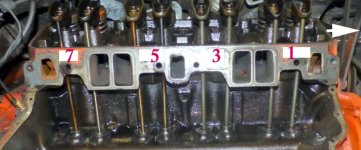
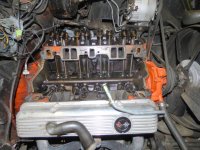
I've got the intake manifold off; it doesn't appear to have been disturbed before (paint undamaged on bolts and paint cover continuous over manifold and heads)
P1030428.JPG
The hold down bolts weren't loose but needed very little torque to break and the manifold lifted away without any crowbar or hide mallet assistance. As it came away, the gaskets dropped off. No signs of any RTV (the original 'China wall' gaskets were still in place - and not leaking! ) nor gasket sealant of any sort. No sign of any leakages either, although possible fuel leakage between ports is not as easy to detect as with other fluids.
Anyway, I'll clean it up and when I get new gaskets, refit it. While I'm waiting for gaskets I need to give some thought on how to re-install it. I no longer have the strength to hold and accurately position a 40lb. lump of cast iron at arms length over the 'Vette fenders.😞
Ho hum, wouldn't be fun if it was easy, would it? ;)
 

teamzr1

Supporting vendor
Could be just a bit of carbon buildup between face of valve and seat that would not be clearly seen in compression test, but enough to cause a bit of misfire
Did they crank engine over with valve cover off and watch the valvetrain closely

Any reason why the color of pushrods look like more heat in them for #7 & 5 ?
Have you checked the lifters seated correctly for all of them and working well and no slight bent of pushrods ?
Maybe just angle of photo, but some lifters seem to be seated bit different height ?


P1030428.jpg
 

antijam

CCCUK Member
Could be just a bit of carbon buildup between face of valve and seat that would not be clearly seen in compression test, but enough to cause a bit of misfire
Did they crank engine over with valve cover off and watch the valvetrain closely

Any reason why the color of pushrods look like more heat in them for #7 & 5 ?
Have you checked the lifters seated correctly for all of them and working well and no slight bent of pushrods ?
Maybe just angle of photo, but some lifters seem to be seated bit different height ?

No, didn't watch the lifters with the valve cover off. All the lifters seem to be seated properly and none of the pushrods obviously bent.
The colouration of the different pushrods is odd. All the pushrods of the RH bank show the same dark colour as those of cylinders 7 and 5; only those of 1 and 3 show the light colour. I can't think of any explanation for this unless a PO changed them at some time?
The car has a dual exhaust system with no CAT's
 

teamzr1

Supporting vendor
Really cannot see close enough in that 1 photo as valvetrain for both heads
It seems looking at how much the manifold gasket was crimped down that Bank 2 had more clamping pressure
then on bank 1

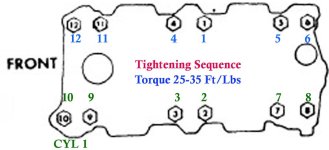
Do you torque sequence pattern as GM specs shown and dual pass of torquing to 25-25 Ft/Lbs ?


.C3intakeseq.jpg
 
Last edited:

Oneball

CCCUK Member
You said you determined which cylinder was misfiring with a timing light? How did you do this and what sort of timing light do you have?
 

antijam

CCCUK Member
You said you determined which cylinder was misfiring with a timing light? How did you do this and what sort of timing light do you have?
I use this Gunson timing lamp. With the engine running I simply fit the inductive pick-up on each HT lead in turn and pull the trigger. If the light doesn't flash then that cylinder isn't firing. If the flash is sporadic or intermittent there's an occasional misfire.
 
Last edited:

teamzr1

Supporting vendor
Since you going through all the time and effort, while having intake off I would hand rotate the engine and assure
the lifters are allowing the valves to fully open and close, including checking the valve springs

Misfire is due to a lousy charge to the cylinders as good air/fuel AFR
including no back pressure of exhaust allowing exhaust gases reverb back into cylinders adding crap charge to next firing of a cylinder or a degraded exhaust manifold gasket allowing air or exhaust sucked into the cylinder
 

antijam

CCCUK Member
Since you going through all the time and effort, while having intake off I would hand rotate the engine and assure
the lifters are allowing the valves to fully open and close, including checking the valve springs
I'll do that JR.(y)
 
Top