Dyno Test

Forrest Gump

CCCUK regional rep
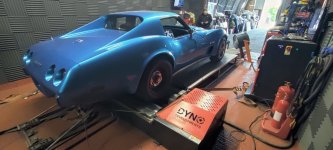
A couple of weeks ago my good friend Mark Eaton and I took a ride out to Mill Lane Speedshop, near Finchingfield in Essex to put my Corvette through its paces on their rolling road dyno.
I put the engine together a few years ago, it drives really well but I always had it in mind that I should get it on a rolling road to check the carb is jetted correctly, and of course to see what the car is putting out - torque and power.
The engine is a stroked small block 383, AFR heads, Magnum 270H cam, 600cfm Holley double pumper, Weiand dual plane intake, Flowtech headers. I spec’d the build primarily for strong mid-range torque. It’s a 4 speed manual with a leggy 3.08:1 diff that I put in to make the revs lower for normal driving - buts that’s why I needed good torque from the engine to turn that diff ratio.

IMG_20260515_135424.jpg

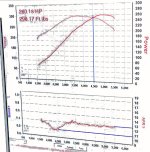
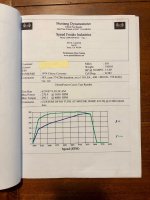
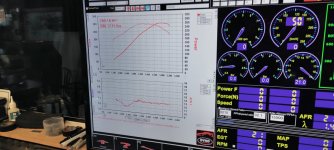
Heres what we got:
The air/ fuel ratio was spot on. The plot shows it goes rich when the throttle is first applied as the pump shot goes through the carb but then it stays right where it should through the rev range. No alterations to the jetting required.

The power figure was a surprise - much lower than I was expecting - the best pull gave 260 bhp at the wheels. I had in mind that my engine was in the region of 380 at the flywheel, so was thinking that would equate to well over 300 at the wheels. Losses from the ancillaries and drivetrain could be much more than I thought but it looks like the engine doesn’t have the bhp I thought either. I read somewhere a dyno test is also known as a dream crusher! Mark was doing his best to console me! It actually got worse, further pulls were in the 245 region due to the engine getting hotter. Best power was at the first pull with the engine temp at around 160F.

What it does have though is a good torque curve through the rev range, particularly at mid revs. This is what makes this car a quick street car - it pulls hard in any gear even from low revs. Power drops off at 5500rpm

The guys at the Speedshop suggested a dyno test and coffee morning which is something Mark and I will organise if there’s enough interest.
IMG_20260515_135303.jpg
 

johng

CCCUK Member
I'm interested in a dyno test and coffee morning Andy. Is the AFR plot just showing what the ratio is whilst the car is accelerating? It seems a bit rich for cruising.
 

Daniel B

CCCUK Member
Dynos are indeed dream crushers. One thing to possibly take into account which is something I've heard from quite a few drag racing guys, is its best to stick to relative changes and not pay too much attention to absolute values, IE make a modification and put the car back on the same dyno and look at the (hopefully) improvement rather than get bogged down with the absolute numbers. I'm told its pretty common that two different dynos at two different places will almost always give quite different results. This isn't because one of them is "wrong" or anything like that its just that minor changes in conditions have big effect.

For example was it hot on the day you tested?
That can sometimes have quite a large detrimental effect?

The one thing I would take away from your pictures though is the curve is very clean and healthy looking. It must be lovely to drive which at the end of the day is the important bit.

If it helps when I get down over the numbers, I convert them to old fashioned gross horsepower, cheating a bit but cheers me up no end :ROFLMAO:
 

Invetterate

CCCUK Member
I'm interested in a dyno test and coffee morning Andy. Is the AFR plot just showing what the ratio is whilst the car is accelerating? It seems a bit rich for cruising.
We thought of you, John, given your interest in AFR! The plot shown is at WOT - the car is pulling hard!

It is really awe inspiring to stand behind the car and hear the fury of a big V8 really going for it - a really good experience all round.

What Andy is too modest to say is that the father and son team who run this business do this all the time and they were impressed - and I mean very impressed - by the build of the engine. They kept repeating this sentiment. The curves of the various pulls were virtually overlaid - lovely to see.

Whatever the numbers, it shows it is linear in power and torque and that the fuelling is spot on. Anyone that is in doubt should ask for a ride in it and see how it pulls - boy, does it pull! Love this engine!!

Re the coffee and dyno morning, John and I will make two - we need at least three more for it to be viable for Mill Lane Speedshop.
 

teamzr1

Supporting vendor
What type of chassis dyno was this, static or load bearing as my thoughts would be different in those results ?
Drivetrain loss for a manual tranny is around 14% and like 17% for a auto tranny so do the math to see what the flywheel numbers is
No one uses BHP numbers as that is of engine on a engine dyno with no pulleys, belts, exhaust so flywheel numbers are used
Owners prefer non load bearing static as the results will always be higher than numbers really are where load bearing numbers will be lower, but if calibrated before runs will be about perfect to real numbers

Torque crossing point to HP is always at 5,250 RPMs, so why was yours 1,000 RPMs less ?

If load bearing, was it calibrated for the weather that day and as to elevation ?

AFR at 2,000 to 2,500 too rich at around 11.0:1, better around 12 ish


.35303.jpg

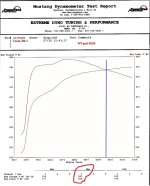
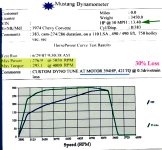
Example of my custom engine'd 1999 C5, notice crossing point
running with NOS rearwheel TQ/HP around 600 (with 3.73 diff ratio)
This was with a load bearing chassis dyno and calibrated right before the pulls


winos.jpg
 
Last edited:

teamzr1

Supporting vendor
@teamzr1 Nice spot!
There is something definitely wrong with that torque crossing point, it should be at 5250.

I suspect being the torque was dropping around 4,200 RPMs that the driver lifted gas pedal too soon
Run should be in a gear ratio of 1:1 (4th gear if manual tranny) and run to redline to obtain best numbers
Maybe also had bit of wheel spin would kill off the top end numbers as the AFR line should not have been as wavy
 

teamzr1

Supporting vendor
If the car is newer where it has engine controller, use a OBD scanner and record the pull

Then take that recorded data and within a spreadsheet can obtain a lot more information of the pull like I do
so now I can tweak the calibration to allow getting the best numbers throughout the RPM, MPH and load windows

D-DynoPower.jpg
 

Forrest Gump

CCCUK regional rep
What type of chassis dyno was this, static or load bearing as my thoughts would be different in those results ?
Drivetrain loss for a manual tranny is around 14% and like 17% for a auto tranny so do the math to see what the flywheel numbers is
No one uses BHP numbers as that is of engine on a engine dyno with no pulleys, belts, exhaust so flywheel numbers are used
Owners prefer non load bearing static as the results will always be higher than numbers really are where load bearing numbers will be lower, but if calibrated before runs will be about perfect to real numbers

Torque crossing point to HP is always at 5,250 RPMs, so why was yours 1,000 RPMs less ?

If load bearing, was it calibrated for the weather that day and as to elevation ?

AFR at 2,000 to 2,500 too rich at around 11.0:1, better around 12 ish

This is the dyno used: Dyno Developments – Dyno Developments

I had noticed afterwards the tq / hp cross point was not at the 5250rpm, so that's puzzling.
I honestly thought the spec of the engine alone would give 1bhp to cubic inch, hence my guess of 380 @ flywheel wouldn't be too optimistic. The car certainly feels like it has that kind of output and that is the important thing I guess.
It would be interesting to get a car with a known bhp engine on their rollers.
The guys at the Speedshop suggested losses at the wheels can be significant especially on older cars with more agricultural drivelines, big radiator fans etc.
 

teamzr1

Supporting vendor
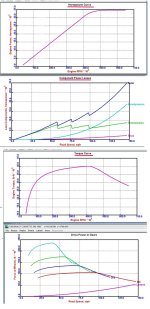
Looking at their chassis dyno specs

Cannot tell for sure if it is a simple static non-load bearing type
or a load bearing type, but I see nothing in specs as to be load bearing it would have to
use water to do the braking so that the drum equals the total weight of the vehicle (including driver weight)
so it is a fair equal load or uses electric brakes to make the drum weight equal the vehicle weight

Static type the drum might weigh 2,700 pounds, but the vehicle under test weighs 3,700 pounds
thus 1,000 pounds difference, so results are not correct

Load bearing type the operator MUST calibrate the drum and braking force to equal the vehicle weight
If not done correctly and also not factoring in for weather and elevation the results numbers would be wrong

Either are easy to cheat the results you want which is common for shops that installation so-called performance mods
On purpose, they make the before the mods report low HP/Tq so that after the mods installed they cheat so
the numbers look much higher and claim their mods created the fake high numbers
Can fake the numbers by too low or too high tire air pressures to mounting the weather station where temp is hotter so that a false D/A is added to the results

Their specs show they only need a 30 AMP single phase A/C circuit
If load bearing using electric brake loading would require a high AMP draw and use 220 volts A/C

The college I taught OBD and custom tuning spent $70,000 for a load bearing 2 and 4wheel vehicles and I found simple mistakes or operator too lazy, or no experience to correctly calibrate dyno for EACH vehicle could produce incorrect performance numbers
As the saying goes, for those dyno queen vehicle owners says to the dyno operator
"You Lie and I will swear the results are correct"

as the higher the bogus dyno numbers, the bigger the waxers balls are :)

IF spending money for chassis dyno tests ask which type of dyno design
Watch and assure they calibrated it for each vehicle before tests and that the weather and elevation was factored in
Also determine if you want tests done with a full tank of added gas weight or very little in the tank
 

Roscobbc

Moderator
Some 10/12 years ago when originally making plans for having the replacement higher powered engine built for my C3 I was visiting a well known engine builder.
By chance he had two other well known UK based V8 engine builders visiting him collecting parts. All three specialised in building hi-end (and street-based) race engines......not so much multi 1000's HP huffed engines......just gas burning street and street and strip engines.
To protect their anonymity I won't reveal their names........but the conversation went along the lines of discussing a UK based racer who had shipped over a new big cube hi-hp big block Chevy engine from Shafiroff Racing Engines c/w proven dyno sheet showing a guaranteed HP figure. Can't recall the exact figure, but it was in excess of 1000 hp and perhaps a $30K plus price.
Racer installed it, raced it and was disappointed with his times. Took it to one of the three builders present who set it up on his Land & Sea brand dyno, and using the required correction figures for UK conditions for that day tested the engine perhaps 5% or 7% short of makers 'guaranteed' figures.
A 5% loss on a 400 hp street engine is perhaps neither here or there, and arguably bad enough, but 5% on a 1500 hp race engine is a disaster (like 75 hp) and a race loser.
The other builders had each experienced similar anonomolies with other engines sourced and tested from the USA. Draw your own conclusions as the the reasons for there variations. Funnily enough my engine dyno'd at 528 hp on it first dyno run. A couple of years later when I needed two new 'rods fitted it then checked-out on the dyno at 570 hp (with no other mofifications) - builder apologied - had used the wrong correction figires on the earlier dyno run ('loosing' 42 hp!) so errors can even occur with the best guys...........
 

teamzr1

Supporting vendor
Lack or no calibration for :
1. total correct weight of vehicle
2. Computing to include elevation
3. Weather
4. Proper correctly lashing down the vehicle to floor of dyno
5. Engine temperature
6. If load bearing, calibrating the dyno for the vehicle weight

Will greatly affect good or bad chassis dyno results

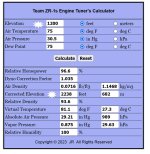
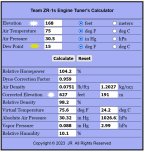
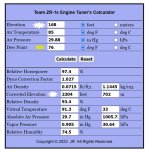
Few years ago I designed and wrote a calculator to determine the DA effect
You can use it at Team ZR-1 Tuning Calculator - Using Dew Point

The top part is here you enter the weather and elevation values, then click on compute
The lower part than does all the math and the results

Examples of just changes to elevation and as you see slight changes as to weather or factoring
for elevation how it would affect dyno results, if DA is not done or wrong calibration for it

If you do not want to spend money for dyno pulls where DA is negative use this first,
The wise guys claiming how great they are going out of their way to find days when DA is negative
means then the HP/TQ would be great so they can brag how great their vehicle mods are

This is like wait for a good DA, drag race that day and claim how fast they are when DA goes up the slower car would be
But these wise guys ever tell the people what the DA was

.DA3.jpgDA2.jpgDA.jpg
If you like the techie info as what this is all about :

The atmospheric pressure, temperature and humidity all affect the density of the air. On a hot day, or at high altitude, or on a moist day, the air is less dense. A reduction in air density reduces the amount of oxygen available for combustion and therefore reduces the engine horsepower and torque.
For tweaking the fuel/air mixture, or predicting engine power, the air density is the most important consideration.

Inputs:
Air Temperature should ideally be the temperature of the air that is going into the intake of the engine.

Altimeter Setting is the value in the Kollsman window of an altimeter when it is set to correctly read the elevation.
The altimeter setting is generally included in NOAA weather data reports.

Dew Point temperature is used in this calculator, rather than relative humidity, because the dew point is essentially constant for a given air mass. That is, the dew point changes rather slowly and is not significantly affected by temperature. On the other hand, the relative humidity changes greatly during the day as the air temperature changes.

Note: The altimeter setting and dew point can often be gathered from a local airport, local weather service or the national weather service.
Altitude is the actual altitude at which the engine is being operated.

Calculated Values:

Relative Horsepower shows how air density alters the power output of a properly tuned engine. For example, at 85 deg F, 30.14 in-Hg altimeter setting, 58 deg F dew point and 5000 ft altitude, the engine only produces about 81% of the rated horsepower.

Note: The relative horsepower calculations are made in accordance with SAE J1349. The standard reference conditions for SAE J1349 are: Air temp 77 deg F (25 deg C), 29.235 Inches-Hg (990 mb) actual pressure and 0% relative humidity.

Note: Section 5.1 of SAE J1349 AUG2004 makes it clear that the equations are not intended to provide accurate corrections over an extremely wide range, but rather that the intended range of air temperatures is 15 to 35 deg C (59 to 95 deg F), and the intended range of dry air pressures is 900 to 1050 mb (26.58 to 31.0 inches-Hg).

Values outside this range may produce inaccurate results for SAE Relative Horsepower and Dyno Correction Factor, but all other calculator results (such as Density Altitude, Air Density, etc) will still be correct.

Dyno Correction Factor, calculated according to SAE J1349 AUG2004, is simply the reciprocal of the relative horsepower value.
Air Density is the actual weight of a given volume of air. This is a key parameter for engine tuning.
Air Density is the actual mass of a given volume of air. This is a key parameter for engine tuning.
Density Altitude is the altitude in dry air that would have the same density as the input conditions.

Note: The ICAO standard conditions for zero density altitude are zero meters altitude, 15 deg C (59 deg F) air temp, 1013.25 mb (29.921 in-Hg) pressure and zero % relative humidity.

Relative Air Density is the ratio of the calculated air density to the air density at sea level using the International Civil Aviation Organization (ICAO) standard reference conditions.

Note: The ICAO standard sea level air density is 1.225 kg/m3.
Virtual Temperature is the temperature of dry air which would have the same density as the input conditions.
Vapor Pressure is the contribution of water vapor pressure to the total absolute air pressure.
Relative Humidity is the ratio of the water vapor pressure to the saturated vapor pressure.
 

Forrest Gump

CCCUK regional rep
Looks like a different scale is used on torque on the left and hp on the right
This is why its not crossing at the correct rpm
Ah yes that explains it, thank you. If we use the left side scale for power as well then the lines do indeed cross at 5250.
 
Top