Big Boy, the only one of eight left
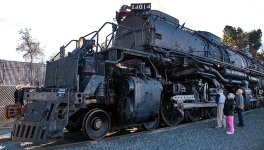
Big Boy No. 4014 is recognized as the world's largest operating steam locomotive. It was built in November 1941 by the American Locomotive Company (ALCO) and is part of the Union Pacific Heritage Fleet. This locomotive is notable for its size and power, designed to haul heavy freight trains, particularly in the challenging terrain of the Wasatch mountain range.
Specifications
Key Features
| Attribute | Specification |
|---|
| Type | Steam |
| Configuration | 4-8-8-4 |
| Length | 132 ft 9 + 7/8 in (40.48 m) |
| Height | 16 ft 2 + 1/2 in (4.94 m) |
| Weight | 1,218,500 lb (609.2 short tons) |
| Power Output | 8,157 hp (6,083 kW) |
| Maximum Speed | 80 mph (130 km/h) |
Fuel and Water Capacity
| Attribute | Specification |
|---|
| Fuel Type | No. 5 fuel oil |
| Water Capacity | 25,000 US gallons (95,000 L) |
| Fuel Consumption | 20–25 US gallons per mile |
| Water Consumption | 200 US gallons per mile |
Restoration and Current Status
Big Boy No. 4014 was retired from revenue service in 1961 and was restored in 2019 after being dormant for nearly six decades. It is now operational and serves as a traveling ambassador for Union Pacific, participating in excursion services across the United States.
In 2026, Big Boy No. 4014 is scheduled for a Coast to Coast tour, starting in California and heading east to celebrate the nation's 250th birthday.
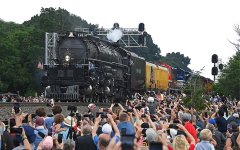
Millions of Americans this month have flocked across the country to see the largest locomotive make its trip across the US in celebration of America's 250th birthday
It's making a celebratory cross-country run for America's 250th birthday across 14 states, starting in
California in April and ending in its home state of
Wyoming and the end of July.
Big Boy's journey started on April 10 in Sacramento, California, at historic milepost zero, where the Central Pacific Railroad began construction on the first transcontinental railroad line in 1863.
The year before, then-President Abraham Lincoln signed the Pacific Railway Act, which authorized the construction of the transcontinental railroad during the Civil War.
Big Boy 4014 is the only operational train of the fleet of 25, which were built in Schenectady, New York, near Albany, between 1941 and 1944.
Each of the locomotive weighs 1.2 million pounds, which is three times the size of today's diesel locomotive;
stands at 17 feet tall, and are 133 feet long, which is a little over half the size of a Boeing 747.
Union Pacific commissioned the massive trains in 1941 'because we needed power to go over the Wasatch Mountain Range in Utah,' Tysver told the Daily Mail.
'They were called the Giants on the Rail,' she said.
The trains ran for 20 years, primarily traveling between Wyoming and Utah. They were slowly replaced in the 1950s and 1960s by diesel trains, as steam locomotives require a lot more maintenance.
After the Big Boys were decommissioned, most were scrapped for metal. Only eight trains survived, Tysver said.
In 2013, Union Pacific started to think about putting together a commemorative train route for the 150th anniversary of the railroad and eventually the 250th birthday of the US.
In 2014, the railroad acquired one of the eight existing trains and took 2.5 years to restore it – making it the largest locomotive restoration project in recent history, Tysver said.
Every year since the 150th anniversary of Union Pacific, the train had made a journey across the company's rail network.
Ahead of the country's semiquincentennial, they began communicating with other railroads such as CSX, Norfolk Southern, and Reading Blue Mountain & Northern Railroad – to use their rail lines to make the cross-country trip.
It's the train's first time traveling through Indiana, Ohio, Pennsylvania, and New York since its initial trip to Wyoming in the 1940s to start work, Tysver said.
Now, millions of Americans have seen and interacted with Big Boy, which is 'thrilling' to Union Pacific, Tysver said.
There's roughly 30 to 40 people on board the train at all times during its journey, with 12 of them operating the steam engine.
.