Are we still convinced that electric vehicles are the best way forward?

Roscobbc

Moderator
Seems that charging technologies of Lithium and other cells is highly complex if looking to preserve battery life, capacity and importantly safety........generally beyond the understanding of many people - if charging system goes wrong or is incorrectly used the end result can be serious and irreversible.............
 

teamzr1

Supporting vendor
In the wake of Hurricane Idalia’s landfall in Florida’s Big Bend near Keaton Beach on Wednesday, a local fire and rescue department has warned owners of electric-powered vehicles including golf carts and scooters that exposure to salt water can cause the vehicles’ batteries to catch fire.

Palm Harbor Fire Rescue on Florida’s Gulf Coast issued the warning on Facebook Wednesday afternoon, telling owners to move their battery-powered vehicles out of their garages if they had come in contact with salt water, to prevent the fire spreading to the structure.

The warning was apparently triggered by a fire in a Tesla Wednesday in nearby Dunedin, a city just south of the unincorporated area of Palm Harbor.

“If you own a hybrid or electric vehicle that has come into contact with saltwater due to recent flooding within the last 24 hours, it is crucial to relocate the vehicle from your garage without delay.,” the post warned.
“Saltwater exposure can trigger combustion in lithium-ion batteries. If possible, transfer your vehicle to higher ground.”

The state fire marshal warned last year in the wake of Hurricane Ian’s devastation of the threat the electric vehicle batteries posed to those living in coastal areas subject to storm surges.

Florida Fire Marshal Jimmy Patronis had previously gone public with his worries before sending a letter last October seeking answers from the National Highway Traffic Safety Administration about what the Sunshine State could be facing in the future.

In a letter sent Oct. 7, 2022, to NHTSA Executive Director Jack Danielson, Patronis set a deadline of Oct. 14 for the national agency to answer questions regarding the threat to Florida firefighters from electric vehicles in the hurricane zone with lithium batteries that have been damaged by exposure to saltwater and eventually ignited because of it.

In the letter, Patronis summarized his own experiences last week when he witnessed first-hand the difficulty firefighters experience extinguishing a fire in an electric vehicle.

“On October 6th, I joined North Collier Fire Rescue to assess response activities related to Hurricane Ian and saw with my own eyes an EV continuously ignite, and continually reignite, as fire teams doused the vehicle with tens-of-thousands of gallons of water.

“Subsequently, I was informed by the fire department that the vehicle, once again reignited when it was loaded onto the tow truck. Based on my conversations with area firefighters, this is not an isolated incident.
As you can appreciate, I am very concerned that we may have a ticking time bomb on our hands.”

Patronis asked five questions, paraphrased below:

  • Has the NHTSA instructed manufacturers of electric vehicles to inform customers about the particular dangers flooding pose to lithium batteries?
  • Does standard firefighter gear protect against gases from EV fires?
  • Should removing EVs from a hurricane zone be a designated duty in storm cleanup efforts?
  • Does the NHTSA have information about specific timelines for the danger from post-flooding fires in EVs?
  • Does the NHTSA have any guidance on locations where compromised electric vehicles can be taken where they can burn out safely?
In an email to The Western Journal on later that week, the NHTSA said it had been studying the impact of saltwater corrosion on electric vehicles for a decade — since Superstorm Sandy in October 2012.

“Fires in electric vehicles can pose unique challenges for firefighters and other first responders,” the email stated. “Since similar issues emerged with EVs after Superstorm Sandy, NHTSA has been researching the effect of saltwater immersion on batteries, and working with stakeholders to equip first responders with best practices on fighting battery fires.”

In 2021, the NHTSA launched a Battery Safety Initiative. According to the website CNET, the goal is to “research areas such as battery diagnostics, management systems and even cybersecurity to ensure future cars with batteries onboard to power the entire vehicle are as safe as can be.”

Until those answers are made clear, however, it’s best simply to understand the dangers and do what we can to mitigate them — including, obviously, keeping salt water away from EVs and EVs away from salt water.

 

teamzr1

Supporting vendor
You will really laugh when you read the following
Imagine this is a person in the US federal government who heads up a group demanding all vehicles in the USA be electric in less than ten years
Yet her own gang cannot drive a distance, need their EVs charged and cannot do so and then blocking a public charge station with a gas based car
so that no one else can use the charger so that only her gang can charge up


teamzr1

Supporting vendor
A family home was lit on fire after their 'electric car' exploded while sitting in their driveway.

Merseyside Fire and Rescue Service rushed to a family home in Bromborough, Wirral at around 10pm on Saturday night after receiving reports that a car was on fire.
The Liverpool Echo reported that the façade of the two-storey family home was blackened by the fire, and that the garage was also previously on fire as well.
One man told the Echo that after speaking to the owners of the car this morning, they believed the cause of the fire was a 'malfunctioning electric car battery'.

He said: 'I was in bed and heard this popping noise. It sounded like fireworks going off.
'I went outside with my mum and there were bright lights with a car up in flames over the road.

'The owner was in the house when it happened but got out. She told me this morning that the car was only a month old with a thousand miles on the clock and the car battery malfunctioned.'
One woman said: 'I heard tyres popping and people came out to see what was going on. Someone started screaming and people rushed out to help.

'I saw it happen, and it looked like the fire was coming from where they charge the car.
The whole thing was up in flames by the end. It was so scary and my little girl was screaming because she thought something had happened to our house.'

A spokesperson for Merseyside Fire and Rescue Service said: 'Merseyside Fire & Rescue Service (MFRS) attended an incident on Cooks Acre, Bromborough, on the night of Saturday, 23 September.
'Crews were alerted at 9.51pm and were on scene at 9.57pm. Three fire engines attended. On arrival, crews found a two-storey detached house with the garage well alight. A car on the drive was also well alight.

'Two firefighters wearing breathing apparatus entered the property under rapid deployment to fight the fire. The fire was extinguished by 10.10pm.
'MFRS carried out home fire safety checks on the properties on either side of the property and left the scene at 12.21am.'

evfire.jpg
 

teamzr1

Supporting vendor
Last October, the EU agreed to ban the sale of all petrol and diesel cars in Europe from 2035 as part of their push to make us all drive battery cars. The 27 EU countries agreed that carmakers must achieve a 100% reduction in C02 emissions by 2035 which would make it impossible to sell a new car that used petrol or diesel.

The UK, now outside the EU and able to make its own laws, passed laws in 2020 that petrol or diesel cars would be banned from 2030 (10 years ahead of the previous schedule). Then a year later it brought in more laws on all forms of transport as part of a broader package of green initiatives aimed at achieving net zero emissions from all forms of transport ten years later.
This was really all about Boris Johnson wanting to look super green at the UN’s COP26 climate change conference in Edinburgh later on in 2021. But Boris was even more net zero demented than most. He pushed plans to create a net zero rail network by 2050. He even launched a consultation to make all planes in Britain run on batteries or windmills or nuclear so that domestic aviation would have zero emissions by 2040.

Last week it suddenly dawned on the UK Prime Minister, Rishi Sunak, that 2030 was an impossible date to force everyone into battery cars, and he announced that 2035 was now the new cut-off date. You can imagine the chaos and confusion of car companies who need stability to plan ahead.

Meanwhile, in Europe, we found out that new post Brexit laws in the EU to protect them from cheap imports would add billions to the cost of pushing everyone onto electric vehicles.
Yesterday the European Automobile Manufacturers Association (ACEA) announced that trade rules covering electric vehicles could cost European manufacturers £3.75bn over the next three years.
The problem is, as always, our clueless politicians. They make laws without any thoughts to the consequences, and this is a perfect example of that incompetence.
In short, Europe does not have the production capacity for batteries to meet this deadline and will therefore have to import batteries from elsewhere and pay a 10% import tariff.

It is almost comical that in the rush to net zero lunacy, nobody thought where the batteries would come from for all these electric vehicles. Once again it is the customer, who finds themselves as a pawn in the EU’s game, will be forced to pay even more.

Let's take a poor green zealot who has, foolishly, believed the climate change lie and bought a brand new electric car.
How easy it is to charge their car depends greatly on the European country they live in. If they are in the Netherlands, they will have 50 chargers per 100 kilometers. If they live in Germany, they will only have 20 chargers for every 100 km.
And if they venture further east to Romania or Greece, they will not be able to find even 1 charger per 100 km of road.
It will be the citizens of these countries who have been forced to buy an electric car, who will be calling roadside recovery very often to bring a battery pack and give them a boost.

In the US, it is no different, with moron Biden’s goal of having electric vehicles representing half of all new vehicles by 2030.
But today the charging network does not exist and many multifamily units (just like Europe), especially in urban areas, have become charging deserts. If only the automotive industry was more vocal about the net zero madness.

But sadly, they have bought into this lie, despite the damage it is doing to their own industry.
Common sense is once again sacrificed on the altar of ideology.
 

Knodty

CCCUK Member
I haven’t read every post on this thread, and apologise if I am mentioning something that has been already stated.

I feel that the infrastructure will never be there for all electric cars as there will never be enough charging points, for example at the motorway services when 100 people plus are looking to charge there vehicles and want to charge their car. Can you imagine the caps at a service station when there aren’t enough charging points for the cars available, and they will be unavailable for 30 mins plus each time. And that is if the owners return to their car or are scheduling a sit down meal also. It’s never going to work.
 

Roscobbc

Moderator
In the USA and Canada it will be virtually impossible - here in the UK a 100 mile journey is considered a long way (and given the levels of congestion and now the Welsh government rolling out a 20 mph urban network in terms of time actually spent in the cars it will effectively be a long way).
But with our colonial friends who perhaps live out in the 'sticks' and think nothing of a 200, 300 or 400 mile journeys (and back same day).......how's that going to work?
 

teamzr1

Supporting vendor
An example of that, one of our team members in central Texas, just to go buy food has to use his SUV with a trailer attached
Round trip is like 4 hours drive time and has to have a large electric cooler in trailer to store frozen food that would defrost before getting home
without the cooler

Or when I used to for 2-week vacation drive non-stop from S.F bay area in Ca to Chicago area mostly I80 west to east, about 2,700 miles where most of those states have lots of empty roads, and another 2,700 miles going back home
Very few gas stations and some of those closed at night, so be very hard to be stopping for hours to fully charge batteries

Where with gas engined Corvette left at 5 AM, stop for 2-hour sleep and hit Chicago by late afternoon next day and not doing 55 MPH.
Think what a EV charge distance would be using higher speeds
 

teamzr1

Supporting vendor

Ask Your U.S. Representative to Support the CARS Act​

Encourage support from lawmakers for this bill:
U.S. Representative Tim Walberg (R-MI) introduced a SEMA-supported bill, the "Choice in Automobile Retail Sales (CARS) Act" (H.R. 4468), to prevent the U.S. Environmental Protection Agency (EPA) from finalizing its proposed emissions standards that seeks to have electric vehicles make up 69% of new vehicles sold by 2032.
The House Energy and Commerce Committee passed H.R. 4468 in July. SEMA is now working to ensure the legislation receives a vote in the House of Representatives.

If passed into law, the CARS Act would stop regulatory overreach by the EPA, allowing consumers to have the freedom to choose the technology that powers their vehicles.
As proposed, the EPA's rules would force auto manufacturers to meet unrealistic mandates driven by the most aggressive light-duty emissions regulations in U.S. history.

Lawmakers Must Hear from You Right Away!​


teamzr1

Supporting vendor
Jackson, Wyoming – Joe Biden boasted two years ago that the CEO of a major electric bus manufacturer was making him “look good” and federal taxpayers dollars poured into the company.
Now those words have come back to haunt him as an entire town’s electric bus fleet backed by the company broke down.

The Cowboy State Daily reported Tuesday that Teton County and the town of Jackson wanted a low-emission transit system for the county. The Southern Teton Area Rapid Transit (START) system, a joint operation between Jackson and Teton County, had bought eight electric buses to complement its fleet of 31.

But the entire electric bus fleet broke down, so the town’s transit system is now solely relying on its diesel fleet.
The last of the electric buses went out of service two months ago, and some of the broken buses have been awaiting parts for months.

Cristina Laila previously reported the electric bus manufacturer that supplied START, California-based Proterra, filed for Chapter 11 bankruptcy last month. Proterra enjoyed large financial support from American taxpayers courtesy of the Bipartisan Infrastructure Law, which was signed into law back in 2021. Laila also notes that dim-witted Energy Secretary Jennifer Granholm was deeply invested in the company.

In addition, Biden also participated in a virtual tour of Proterra that year, he can be seen hailing then-CEO Jack Allen and makes a remark we can now say came back to haunt him:
 

teamzr1

Supporting vendor
What a total joke and $7 billion bucks of taxpayers money given to japan

A $4 billion Panasonic electric vehicle battery factory in De Soto, Kansas, will help satisfy the Biden administration’s efforts to get everyone into an EV.

It also will help extend the life of a coal-fired power plant.

Panasonic broke ground on the facility last year.
The Jap company was slated to receive $6.8 billion from the Inflation Reduction Act, which has been pouring hundreds of billions into electric vehicles and battery factories as part of its effort to transition America away from fossil fuels.
The Kansas City Star reports that the factory will require between 200 and 250 megawatts of electricity to operate. That’s roughly the amount of power needed for a small city.

In testimony to the Kansas City Corporation Commission, which is the state’s equivalent of the Wyoming Public Service Commission, a representative of Evergy, the utility serving the factory, said that the 4 million-square-foot Panasonic facility creates “near term challenges from a resource adequacy perspective,” according to the newspaper.
As a result, the utility will continue to burn coal at a power plant near Lawrence, Kansas, and it will delay plans to transition units at the plant to natural gas.

The Biden Regime is FORCING electric vehicles on the American people, and China controls the critical minerals needed for the car batteries.
Ford Motors has poured billions of dollars into producing electric vehicles as the Biden Regime wages war on gas-powered vehicles.
The electric vehicles have proven to be a money pit for Ford.

Virtually nobody wants electric vehicles.

One in five electric vehicle owners in California switched back to gas-powered because of the inconvenience of charging.
It only takes a few minutes to fill up a gas tank, yet some electric vehicles need several hours of charging to drive only 35 miles.
Charging electric vehicles is a total “hassle” say 20% of EV owners surveyed between 2012 and 2018, so they’re going back to gas, researchers found.
 

FIVE RED

CCCUK Member
The Kansas City Star reports that the factory will require between 200 and 250 megawatts of electricity to operate. That’s roughly the amount of power needed for a small city.
Could never buy into the electric vehicle thing, this just sums up the hidden costs in the so called 'save the planet' debate. Long live the V8 I say (y)
 
Last edited:

Roscobbc

Moderator
And you can almost guarantee had the car been involved in a collision due to the fault the makers would have initially used some form of deniability. VOSA need all owners to return vehicles to dealers for checks. Even something seemingly simple in conventional ICE cars like an engine failing/cutting out at speed can for some drivers prove very difficult with potentially no power steering, followed by minimal braking assistance after a few pedal applications. For someone non-car 'savvy' with low muscle strength it would seem like the steering has locked-up and the brakes wouldn't slow the car down.
 

Steven Smith

CCCUK Member
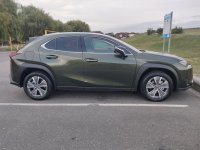
Just taken delivery of my electric Lexus, as a company car it's a no brainer.
Electric cars only attract 2% BIK (benefit in kind, tax) where hybrid cars are at least 25%. So by going electric saves me a fortune and gives me more money to spend on the C4👍, not told the wife that bit yet 🤣
So far it's amazing to drive, instant power at any speed, comfortable, every gadget you could think of and cheap to run.
As a company car I think is great, would I buy one with my own money, no I don't think I would.

IMG_20231005_082933.jpg
 

Chuffer

CCCUK Member
Just taken delivery of my electric Lexus, as a company car it's a no brainer.
Electric cars only attract 2% BIK (benefit in kind, tax) where hybrid cars are at least 25%. So by going electric saves me a fortune and gives me more money to spend on the C4👍, not told the wife that bit yet 🤣
So far it's amazing to drive, instant power at any speed, comfortable, every gadget you could think of and cheap to run.
As a company car I think is great, would I buy one with my own money, no I don't think I would.

View attachment 24501
The tax incentives issued by our devious politicians with their own agendas are designed to dupe Joe Public into EV`s with no thought given to the bigger picture of how they can achieve their crazy schemes .
 

Steven Smith

CCCUK Member
Anyone wondered why car insurance has gone up so much this year ?
One of the reasons is the unexpected and rapid growth in EV's on the road.
Repair costs after accidents have rocketed, a lot of EV's are a total loss after what appear to be only minor accidents, which would be repaired on any engine based vehicle, due to battery integrity being compromised or the risk of it being so.
With so many "ordinary family cars" being electrified and costing upwards of £50k this is turning out to be very expensive for insurance companies and many are losing money on vehicle insurance.
 

Roscobbc

Moderator
The cause of that major fire at Luton airport is being kept rather quiet isn't it - people are presuming and electric car although a fire chief believes it originated from a diesel car.
 

Chuffer

CCCUK Member
The cause of that major fire at Luton airport is being kept rather quiet isn't it - people are presuming and electric car although a fire chief believes it originated from a diesel car.
I will put my money on it being an EV that caused the blaze .
 
Top