Are we still convinced that electric vehicles are the best way forward?

Roscobbc

Moderator
A new study called “Overcharged Expectations” claims that without federal subsidies, the real cost of fueling an electric vehicle would amount to $17.33 per gallon of gasoline.

The study from the Texas Public Policy Foundation said electric vehicles do not stand alone in comparison with other vehicles because of the “wide array of direct subsidies, regulatory credits, and subsidized infrastructure that contribute to the economic viability of EVs.”

“Adding the costs of the subsidies to the true cost of fueling an EV would equate to an EV owner paying $17.33 per gallon of gasoline. And these estimates do not include the hundreds of billions more in subsidies in the Inflation Reduction Act,” the report said.

The study claims that a 2021 electric vehicle “would cost $48,698 more to own over a 10-year period without $22 billion in government favors given to EV manufacturers and owners” and said traditional gasoline-powered vehicles are cheaper than an electric vehicle without subsidies.

“It is not an overstatement to say that the federal government is subsidizing EVs to a greater degree than even wind and solar electricity generation and embarking on an unprecedented endeavor to remake the entire American auto industry,” the report said.
According to the study, about $22 billion in various federal and state forms of aid have artificially lowered the price of a 2021 electric vehicle by almost $50,000.

The report further estimates that the cost to other people for the strain on the power grid from charging electric vehicles comes out to $11,833 over 10 years, funded by taxpayers and utility ratepayers.
While everyone else pays more, state and federal subsidies shave $8,984, on average, from the real cost of an electric vehicle over 10 years, the report said.
“The stark reality for proponents of EVs and for the dreamers in the federal government, who are using fuel economy regulations to force manufacturers to produce ever more EVs, is that the true cost of an EV is in no way close to a comparable,” the report said.

The report noted that consumers have taken to hybrid vehicles far more than electric vehicles, adding, “Perhaps if D.C. politicians and bureaucrats stop trying to force Americans to build and buy their preferred types of vehicles, the cleaner and brighter future that they imagine will actually materialize.”
“It’s time for federal and state governments to stop driving the American auto industry off an economic cliff and allow markets to drive further improvements in cost and efficiency,” the report stated.

In a release on the foundation’s website, study author Jason Isaac said that the cost on the sticker of an electric vehicle hides a lot.

“The Biden administration and leftist states such as California have pushed for widespread electrification in less than 20 years through government subsidies and coercive regulations, but the price you see in the lot is not the true cost of an electric vehicle,” he said.

“Electric vehicle owners have been the beneficiaries of regulatory credits, subsidies, and socialized infrastructure costs totaling nearly 50 thousand dollars per EV. These costs are borne by gasoline vehicle owners, taxpayers, and utility ratepayers, who are all paying a hefty price for someone else’s EV,” he added.
“Proponents of EVs have falsely pushed the claim that EVs will soon cost less than gas-powered cars.
This study shows that EVs are still a long way from being competitive without massive subsidies,” study author Brent Bennett said.

“The Biden administration’s stringent fuel economy standards and regulatory manipulations are driving American automakers toward bankruptcy and adding thousands of dollars to the cost of every gasoline vehicle.
Rolling back these subsidies and burdensome regulations would save consumers money and stop the auto industry from falling off a financial cliff,” he said.

Wonder how the overall cost implications of 'rolling-out' synthetic gasolene would compare with the 'models' shown above?
 

teamzr1

Supporting vendor
General Motors is offering $1,400 to owners of the 2020-2022 Chevy Bolt to entice them to install a diagnostic program that will determine if their battery is defective.
The move is reportedly part of an anticipated class action lawsuit settlement related to the battery problems that have plagued GM’s all-electric car.

In exchange for installing diagnostics software that GM says will detect whether batteries require a full replacement, the company is offering $1,400 to ’20-’22 Chevy Bolt owners, according to a report by Electrek.

GM was forced to recall all of its Chevy Bolts after most of the electric vehicles were found to have a battery defect from supplier LG.
The company now has to take the model out of production for a number of months, and later promise battery replacements to all affected owners.

Over the summer, GM said it would stop replacing 2020-2022 Chevy Bolt Batteries and instead verify the battery’s durability with software that monitors the battery over 6,200 miles, during which time Chevy Bolt owners are only allowed to charge the batteries up to 80 percent, further limiting the range of their EVs.

“GM will provide owners of certain 2020-2022 Chevrolet Bolt EV and EUVs covered under a previously announced recall a new advanced diagnostics software,” a GM spokesperson said. “The software will continually monitor the battery to detect any potential anomalies and, if none are detected after approximately 6,200 miles (10,000 km) of use, the battery will automatically return to 100% state of charge without a return trip to the dealer.”

“If an anomaly is detected, the software will alert the owner via a message on the driver information center and the owner should then contact their dealer to schedule a battery or module replacement,” the spokesperson added.

Many customers were reportedly upset about not receiving a new battery after being promised one from the automaker. Moreover, customers were not pleased with having to restrict charging their EVs for several months while the software monitors their battery.

Therefore, the company appears to be trying to lure customers into installing the software — which GM bills as a “remedy” — by offering the payment early and upfront.
“GM is announcing a compensation program for 2020-22 Bolt EV/EUV owners upon installation of the final advanced diagnostic software as part of the original battery recall,” a GM spokesperson said on Sunday. “Owners are eligible to receive a $1,400 Visa eReward card upon installation. This applies to Bolt EV/EUV owners in the US only.”

But customers have to install the software before December 31, 2023, as well as sign a legal release associated with taking the money, in order to get the early compensation. If they don’t, then they will have to wait and see what happens with the class action lawsuit, Electrek reported.
 
Last edited:

teamzr1

Supporting vendor
After investing 10s of billions of taxpayers money into a green energy agenda mimicking President Joe Biden’s federal rules, American automakers are quickly learning that Americans are not buying electric vehicles (EVs) at the rates they expected.

Data from Edmunds.com shows that in September 2022, for example, EVs sat on dealership lots for just 21 days before they were sold.
Today, EVs are sitting on dealership lots for 65 days.

Automakers, as reported, are well aware of the issue. Tesla, General Motors (GM), Mercedes-Benz, and Ford have all started slow-walking their rapid EV production plans.

In September, most notably, Ford announced it would be pausing construction of a $3.5 billion EV battery plant in Marshall, Michigan. Ford drew fierce backlash from locals and lawmakers because the plant would have the automaker collaborate with China’s Contemporary Amperex Technology Co. (CATL), linked heavily to the Chinese Communist Party (CCP).

GM CEO Ahole Mary Barra told investors in October that the automaker is abandoning its goals to produce 400,000 EVs from 2022 through mid-2024. Similarly, GM will delay retooling its plant in Orion Township, Michigan, to build EV pickup trucks.

Meanwhile, Tesla has seen a dip in net income, which came in at $1.85 billion in the third quarter. At the same time in 2022, net income for the electric automaker was $3.29 billion. As a result, Tesla is planning to delay its production plant set for Mexico.

At Mercedes-Benz, EVs are so hard to sell that the automaker is having to effectively put them on clearance at enormously discounted prices to get them off dealership lots, according to Business Insider:
Meanwhile, Mercedes-Benz — which is having to discount its EVs by several thousand dollars just to get them in customers’ hands — isn’t mincing words about the state of the EV market. [Emphasis added]
“This is a pretty brutal space,” CFO Harald Wilhelm said on an analyst call. “I can hardly imagine the current status quo is fully sustainable for everybody.” [Emphasis added]
But Mercedes isn’t the only one; almost all current EV product is going for under sticker price these days, and on top of that, some EVs are seeing manufacturer’s incentives of nearly 10%. [Emphasis added]

Even with massive taxpayer-funded subsidies spearheaded by the Biden administration, EVs remain a costly expense for America’s working and middle class, which rely on their vehicles immensely.
The average EV, in October, cost nearly $60,000 without the Biden tax credits more than $10,000 above the average industry price, according to figures published in the Detroit Free Press.
In addition to high prices, EVs have enjoyed a stream of bad public perception for some time between the long hours of charging the vehicles, the lack of charging stations across the United States, and the fact that the biggest proponents of green energy policies continue to drive gas-powered cars themselves.

Most recently, Biden’s Energy Secretary Jennifer Granholm took off on an EV tour across multiple states over a four-day period to bring attention to the efficiency of the vehicles.
The trip ended in chaos when the police were called as Granholm’s team blocked a charging station to reserve it for the secretary because there were not enough stations available at the time.

Republicans on the House Oversight and Accountability Committee have since opened an investigation into the matter.

Then, there is the risk of EVs catching fire.
Local firefighters in Colorado have said they still do not know how best to put out a fire involving an EV because the vehicle uses lithium-ion batteries.

“We have fire agencies that are using tarps to cover cars to help try and smother them, but it’s not very effective,” local firefighter official Doug Saba told CBS Colorado in August:

They’re trying water, but you need to have copious amounts of water, 20,000 gallons. Even then, once you put it out, it can rekindle and restart 24, 72 hours or a week later.
Our tactics as firefighters right now is get the vehicle out of the house, get it out of our neighborhood, and we will investigate it in an open field

Many American autoworkers have been sounding the alarm on Biden’s rapid transition to EVs for quite some time. Production of EVs takes far less manpower and reliance on China for critical components of EV batteries.

Thus, autoworkers see their jobs going out the door.

“I think EVs are going to wipe us out,” 28-year-old Whitney Walch, who works at Stellantis’s Portland Parts Distribution Center in Beaverton, Oregon, told E&E News recently. “
[EVs] don’t need spark plugs, what else, oil filters, we sell a lot of those. If we don’t have all those parts, I feel like we don’t have a lot to do.”

Another autoworker said that “it’s almost inevitable” that his job will be eliminated if the Biden administration gets its way on EVs.
 

teamzr1

Supporting vendor
After investing billions to adhere to Joe Biden’s green energy agenda, General Motors (GM) is backtracking on all fronts when it comes to Electric Vehicles (EVs).

As GM was the last of the Big Three to strike a tentative agreement with the United Auto Workers (UAW), the automaker’s green energy dreams championed by the Biden administration have come crumbling down.

GM CEO Mary Barra, a close ally of Obama/Biden’s, has said the automaker will not begin to attempt to produce 400,000 EVs from 2022 through mid-2024 as initially planned. GM is also delaying retooling its plant in Orion Township, Michigan, to build EV pickup trucks.

Days ago, GM had to begin offering owners of its Chevy Bolt about $1,400 to install a diagnostic program to determine if the vehicle’s EV battery is defective. The move came after GM had to recall all of its Chevy Bolts due to the EV battery issues, and a class action settlement over the battery problems is anticipated in the near future.

In addition, GM executives are having to delay launching a number of their EV models such as the Chevrolet Equinox EV, the Chevrolet Silverado EV RST, and the GMC Sierra EV Denali.

Those launch delays have coincided with GM and Honda ending their billion-dollar joint venture to produce affordable EVs for Americans as well as markets in South America and China.
The end of that joint venture comes as demand for EVs among Americans has plummeted, with the all-electric cars staying on dealership lots for an average of 65 days, way up from last year’s average of about 21 days.

“The American public is not ready for the broad adoption of electric vehicles. There are maybe 10 percent to 12 percent of people who really want an electric vehicle, the remainder still want internal combustion,” former GM executive Bob Lutz said this week.

Aside from potential customers, autoworkers at GM have largely been turned off EVs and Biden’s green energy agenda that seeks to foist them on the American public. As part of its deal with GM, the UAW made sure to bring the automaker’s EV plants into its tentative contract so that workers will score higher wages than currently.

GM executives had hoped to keep autoworkers at its EV plants out of such contracts.
Also, significant is the deal’s strike provision, which gives GM’s employees the right to strike whenever the automaker closes one of its plants.

While GM stumbles, China is ready to flood the U.S. market with cheap EVs.

Breitbart News Senior Editor-at-Large Rebecca Mansour has long warned that without major investment in domestic manufacturing and autoworkers, steep tariffs, and time for American automakers to adjust, China will dominate the EV industry.

“A Biden-led administration’s rapid push towards an all-electric future would rob U.S. autoworkers of the advantage of experience and U.S. auto plants of the advantage of previously built manufacturing capacity,” Mansour wrote in October 2020. “Rushed and without tariffs, most of this will likely end up in China — just like all the rest of American manufacturing, thanks to decades of failed trade policies like Joe Biden’s.”

China already has a major advantage over the U.S. in that it controls much of the EV lithium-ion battery supply chain, including minerals such as nickel, graphite, lithium, and cobalt.
 

teamzr1

Supporting vendor
Google’s ambitious dive into the world of electric transportation faced an unexpected roadblock… or rather, a hill.

According to World Peace Exclusive, the tech’s lauded “100% Electric Bus” took on San Francisco’s iconic hilly terrain, only to lose electric power midway up, roll backward, and turn into a four-wheeled pinball, colliding with reportedly a total of nine vehicles on its unintended descent.

The electric behemoth (can seat 60 people) is part of Google’s fleet of approximately 140 luxury buses, primarily used to transport Google’s employees from various parts of San Francisco, the East Bay and other Bay Area locations to the firm’s Mountain View headquarters.

However, the recent accident involving the electric bus in San Francisco indicates that Google’s ambitious eco-friendly initiatives may have a few bumps or rather, a few rolls to iron out.
The incident shone a light on the potential issues of powering large vehicles up the city’s famously steep hills.

As the bus lost power, it began to roll backward, creating a path of mild destruction by colliding with nine vehicles on its way down, according to World Peace Exclusive.

Google has made no official comment on the incident, and no information is currently available at this time.

The San Francisco Municipal Transit Authority (SFMTA) passed a resolution in 2018 to convert its bus fleet to 100% electric by 2035.
The resolution requires SFMTA to begin purchasing 100% battery-electric buses (BEBs) starting by 2025.
The first ten battery-electric buses have entered revenue service.

The SFMTA’s Sustainability and Climate Action Program explains that the agency’s greater goal is an all-electric fleet and a carbon-neutral San Francisco by 2040.
 

Roscobbc

Moderator
We've read, heard (but hopefully haven't personally experienced) the theft of catalic converters from cars for the rare metal content. We've also heard about organised gang theft of hi-end Range Rovers, Merc's, Audi's etc which get shipped over to Eastern European and African destination - and the 'Chop Shops' that cut-up higher-end vehicles for body panels, engines and transmissions. We are hearing that electric vehicles are getting far more expensive to insure due to reported battery failures, fires and the extreme cost of replacement. I wonder in a few years once we start to see even more electric vehicles on our roads and their respective batteries reach 'end of life' if we'll start to see theft of these vehicles for their batteries by 'Chop Shops' and resale on to end-users at seemingly bargain prices unconcerned about where they originated.
 

CaptainK

Administrator
The other thing that crossed my mind about some battery cars, was around the concept of having the battery pack "quick swappable" so that you could recharge your car quicker by swapping a fully charged one in. BUT, if its that easy and convenient to "quick swap" the battery, then I bet the thieves are one step ahead and will have that out quicker than they currently do with a CAT theft. I could imagine cars with "quick swap" batteries would see their insurance premiums soar more after that.
 

Roscobbc

Moderator
The other thing that crossed my mind about some battery cars, was around the concept of having the battery pack "quick swappable" so that you could recharge your car quicker by swapping a fully charged one in. BUT, if its that easy and convenient to "quick swap" the battery, then I bet the thieves are one step ahead and will have that out quicker than they currently do with a CAT theft. I could imagine cars with "quick swap" batteries would see their insurance premiums soar more after that.
We'll probably be told by the manufacturers that only certified dealers will have the equipment to remove/replace batteries........that doesn't seem to be a barrier to people using Tesla components. Given the currently higher numbers of Tesla's out there (as compared with other electric vehicles) and the elevatated prices plus controlled availability they maintain I would have guessed thet would be one of the first cars to suffer battery thefts.
 

teamzr1

Supporting vendor
The E-Ray owner's manual states that you must put a charger on the 12V stater battery if the E-Ray sits for more than a week.
The battery charger for a Lithium battery is not the same as a regular lead acid one, it's a higher voltage.
This means you will need a battery maintainer for that and another one for the car's main battery

Also
The manual in that E-Ray electric motor requires an oil change at every 15 hours of track use and the word is not an easy task to do
 

teamzr1

Supporting vendor
New York is staying with traditional diesel-powered snow plows after rejecting electric vehicles proposed as a replacement.

Just over three years ago, the New York Department of Sanitation sought several Mack electric trucks to be set up for double duty as part of a goal to become CO2-neutral.

New York differs from many cities in that its garbage trucks double as snow removal vehicles when and if required.

Primarily intended to clean streets and remove garbage, one of these Mack trucks had been fitted with a snow plow as part of an experiment. Essanews reports the move has been a failure. The reason was given as a simple lack of power:

The plow, dragging across the road and the snow buildup in front of it, created substantial resistance.
Moreover, the plow required almost constant movement, eliminating the option for loading pauses.

Consequently, the electric vehicle’s power supply was insufficient for the demands of a New York winter, known for its heavy snowfall.
The report further detailed that after only two hours, the electric plow had to discontinue the route for recharging.

While the truck was efficient for garbage collection, its performance significantly dipped when faced with the snow removal tasks.

The vehicles could operate a maximum of only three hours, despite the real need being 12 hours.
The Vice President of Mack confirmed that with the current technology, considering battery efficiency and their weight, it is not feasible to provide the Department of Sanitation with electric vehicles capable of snow removal as stated on the website.

This implies diesel trucks will continue in operation, and this scenario is unlikely to change soon, notwithstanding the previously outlined plans to phase them out by 2040 even as New York still struggles to keep the streets clear with current equipment.

The New York Sun flagged the failure just over 12 months ago when it first reported, “New York City officials say the electric garbage trucks it has purchased in the name of combatting climate change cannot do double duty as snowplows ‘they basically conked out after four hours.’”

The outlet concluded, “the future of snow removal is probably diesel.”

18.jpg
 

teamzr1

Supporting vendor
AUBURN HILLS, Mich. (AP) — Automaker Stellantis on Wednesday announced a recall of more than 32,000 of its hybrid Jeep Wrangler SUVs
because they pose a potential fire risk.

As part of what the company described as a routine review of customer information, Stellantis determined that 40 of the hybrid Wranglers had caught fire while they were turned off and parked.
18 of the vehicles were being charged when the fires started.
The company said it doesn’t believe anyone was hurt in the fires.
The recall covers 2021–2024 models of the Jeep Wrangler 4xe SUVs.
All other Wrangler models have been deemed safe by Stellantis, which maintains its U.S. headquarters in Auburn Hills, Michigan.
The SUVs affected by the recall can still be driven until they are fixed, but Stellantis is recommending they be parked away from buildings
and not be charged until they can be repaired.
The fixes involve either resetting or updating the software, or replacing the vehicle’s battery pack.
Stellantis plans to contact the owners of the SUVs that need to be fixed.
 

teamzr1

Supporting vendor
EV owners report far more problems with their cars and trucks than owners of gas-powered vehicles, according to a new survey.

Vehicles in the burgeoning electric vehicle segment, from model year 2021 through 2023, encountered 79 percent more problems than those with combustion engines, according to a Consumer Reports survey of more than 330,000 car owners.
The research said EV owners most frequently reported troubles with battery and charging systems, as well as flaws in body panels and the fit of interior parts.

Consumer Reports noted that reliability concerns will cause additional apprehension among prospective buyers, alongside concerns about higher costs, too few charging stations and long charging times.
The growth of EV sales has slowed sharply since last year, and concern has heightened that American consumers are simply not prepared to make the switch from gas-powered cars.

In June 2022, EV sales were growing about 90 percent year over year. But by June of this year, the 12-month growth rate had slowed to about 50 percent. Automakers have become increasingly fearful the pace will weaken further.

And this week, about 3,900 auto dealers signed a letter to Joey Biden asking him to rethink what they described as unrealistic fuel economy and emissions requirements.
'They are not selling nearly as fast as they are arriving at our dealerships, even with deep price cuts, manufacturer incentives and generous government incentives,' the letter said.
 

Pinhead

CCCUK Member
The additional faults over internal combustion is quite probably the tesla effect
While the main parts of the car are very well made and designed
Much of the less important things to the functionality of a car are just thrown together
The vast majority of tesla warranty issues tend to be creaks, rattles, incorrectly installed seals allowing water in to the cabin door handles etc
As well as many problems with software
Much of which is labeled as beta and there is no actual fix with software updates often breaking some things while fixing others

But the actual stranded at the roadside type of faliure is very very small
This is not really an ev issue as such more just a tesla issue and In North America they sell just about as many evs as the rest of the manufacturers put together

And even with all their faults I think they make a great daily
Having had a model S for 5 years and added 100k Miles to it its had one break down that renered it inoperative
A broken can wire to the rear motor
Similar failures often happen with internal combustion but would usually result in a limp mode situation
Other than that it's cost very very little to own and run aside from depreciation
I have fitted a load of front suspension parts to get rid of a knock its still on factory brakes at 120k and 3rd set of tyres
Electric costing on average 1.5p a Mile

It's off in January and a new model 3 facelift will replace it as a company car
Then hopefully the release of capital from my car will allow me to get a C7 that I have been hankering after
 

Roscobbc

Moderator
The additional faults over internal combustion is quite probably the tesla effect
While the main parts of the car are very well made and designed
Much of the less important things to the functionality of a car are just thrown together
The vast majority of tesla warranty issues tend to be creaks, rattles, incorrectly installed seals allowing water in to the cabin door handles etc
As well as many problems with software
Much of which is labeled as beta and there is no actual fix with software updates often breaking some things while fixing others

But the actual stranded at the roadside type of faliure is very very small
This is not really an ev issue as such more just a tesla issue and In North America they sell just about as many evs as the rest of the manufacturers put together

And even with all their faults I think they make a great daily
Having had a model S for 5 years and added 100k Miles to it its had one break down that renered it inoperative
A broken can wire to the rear motor
Similar failures often happen with internal combustion but would usually result in a limp mode situation
Other than that it's cost very very little to own and run aside from depreciation
I have fitted a load of front suspension parts to get rid of a knock its still on factory brakes at 120k and 3rd set of tyres
Electric costing on average 1.5p a Mile

It's off in January and a new model 3 facelift will replace it as a company car
Then hopefully the release of capital from my car will allow me to get a C7 that I have been hankering after
But are your running costs based on use in UK - and based on use of 'home' charging (and what ever KW charger you have installed) - 'free' Model S charging at Superchargers - or a charging mix?
 

Pinhead

CCCUK Member
But are your running costs based on use in UK - and based on use of 'home' charging (and what ever KW charger you have installed) - 'free' Model S charging at Superchargers - or a charging mix?
Yes uk based costs
Mainly charging at home
Initially I had a home tarrif of 13.3p/kwh peak 5p/kwh off peak the way that my contracts renewed I missed the worst of the energy crisis but once I did hit that about 18 months ago peak went up to 39p and off peak 10p luckily this only lasted about 6 months and the rate came down again 30p peak and 7.5p off peak
As I could see the energy crisis coming I fitted solar and home battery system mainly to stave off peak rate use this has kept my monthly bills right down now paying less than I was before the price went up with a 12 months average bill for a 3 bed semi and a tesla doing 20k miles about £60 a month and a credit building up on my account as I am still paying the same DD
The car has a lifetime usage of 3 miles/kwh it uses more in winter and less in summer
I have free supercharging but don't use it that much maybe 15% of all charging
The average cost over 5 years will be about 6pkwh for home charging but working it our exactly will be hard work and I cannot be bothered
As for car maintenance its needed very little
I do most things myself
Annually I strip down the brakes and clean them out as lack of use due to regen can have them seize up
Front suspension rebuild this summer due to annoying rattle it still passed the mot but the quite ride of an ev means rattles are even more noticeable and annoying
1 break down broken can wire
Wheel refurb due to kerb rash and corrosion
12v battery went swapped over before a break down thanks to warning on yhe dash
I also had it down to cleevley EV for a service a couple of years ago they inspect all the HV stuff and check for integrity
This was £120
Had a coolant leak while still in warranty quickly sorted and had a loan car while it was done
The mcu was subject to a recall and done foc Inc loan car
I paid for an upgrade to allow the use of CCS chargers as this is the new standard and my car was a tesla propitary system before standards were set out
That's about it
The biggest cost has been depreciation by far I paid £43k for the car and I expect to acheave about £17k when I sell it
 

Roscobbc

Moderator
I'm retired now and the mileage I used do gradually got lower each year (as my customer base mainly concentrated London useage and more use of tube/rail travel) and eventually ended-up at a lowly 18-20K miles pa (from a 35K and a peak further back some time previously of 45K miles pa). Vehicles was always company supplied and 3/4 year full service contract hire.
I did have the option of sourcing my own vehicle but with comparitively low mileage the figures didn't work out. Had I have been 'covering' a larger UK area and doing far higher mileage for me a Model S would have worked out quite well over a 3/4 year period and the high purchase cost would have been comfortably amortised by use of 'free'. Living 10 minutes off the Eastern side of the M25 and the fact that I'd be travelling past South Mimms Services and its supercharger stations and their 'free' Model S charging would jave been a bonus and quite possibly have sufficed generally. It seems that Volvo are the only major car manufacturer to have grasped the current reluctance of many car owners to 'invest' in an electric vehicle with their new XC30 suv range (starting at £33K)
 

Pinhead

CCCUK Member
It was a massive leap of faith just over 5 years ago these things were rare especially outside London where people bought them to save the congestion charge
But I am glad I did if I hadn't jumped then and learnt for myself how good the cars are I probably wouldn't want to now with all the mainly false negativity towards them
I still don't think they work for everyone and there are many challenges to overcome
People that live in flats and streets of terraced houses with no off street parking being some of the hardest cases to work out
Waking up every morning with a full tank is a true joy and although charging on a long trip takes a little more time than internal combustion would with careful planning timing the stops to coincide with a meal break for example can keep the disruption right down
The car that it replaced was an old astra diesel it said it did 55mpg but it lied it only actually acheaved mid 40s the annual spend on fuel was £3500 add the additional servicing cost and higher road tax and overall cost of ownership is very similar
And I would much rather drive a tesla than a rattly old diesel
Now if we had had a car of similar size and performance as the model S the sums would significantly move in favour of the S
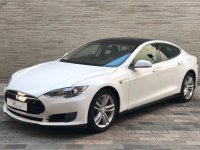
If you don't above average Miles then I can see the sums not working as well and I have a freelander2 for knocking about locally and towing the caravan as my wife takes the tesla most days doing more miles than me for work for which she gets 50p a Mile 45p tax free and 5p that is taxed this is what it looked like when i picked it up f9c2922161654f76b37a4606ed193198.jpg
 

Nassau65

CCCUK Member
Looks very smart. Was hoping Tesla would have produced the S in an estate version by now so I could get one. A couple of friends have run them for 4/5 years and love them
 

Roscobbc

Moderator
Used prices of Tesla S have always seemed to remain very strong - and seemingly irrespective of mileage and age. For me even the electric (now discontined) equivalent to my VW Up! petrol runaround (with its typical 5K pa mileage) just wouldn't make economic sense unfortunately
 

teamzr1

Supporting vendor
Not sure what
"But I am glad I did if I hadn't jumped then and learnt for myself how good the cars are I probably wouldn't want to now with all the mainly false negativity towards them"
Means

But as example City of New York here in the USA replaced most of their vehicles from gas to electric, taxpayer money by Billions were given to them to buy these electrics and was found out last year that they have hidden hundreds of these electrics in an out of way field where they let the weeds just grow high, so the public would not catch on

When caught, their excuse was they cannot repair them as the costs of replacement of batteries and labor was more than the vehicles were worth and demanded the feds via everyone in the USA's federal tax dollars give them billions of dollars to repair them

The game here is the feds conned people into buying electric by giving them $7,500 per electric, which again comes from the taxpayers
But when the total costs came in and when it hits those buyers the repair costs, they dump these electrics

For those that drive only a few miles, electric may be fine
But try as I used to do often drive from the West Coast VIA I-80 highway for 2,500 miles plus in 2 days and lucky if a gas station every 300 plus miles and worse is at night when some of those gas stations are closed.
Most of all the states west/east is farm or ranches, few gas stations, no easy places to even find charge stations

I80.jpg

Try that with electric and how many hours parked getting charged up

So maybe works better where travel is short,
but not here in the USA where I know people that have to drive 400 miles round trip just to go by food and that is pulling a trailer
to haul all, they bought in once a month shopping

Where I live is a rental complex of over 400 living units,
the owner has installed zero charging stations and since people rent they have no OK by owner to install their own chargers or even the
A/C power breaker panels being able to handle another 50 plus AMPS draw

Best is they design nuke powered engines, I would be for that :D
 
Last edited:
Top