Are we still convinced that electric vehicles are the best way forward?

Lewis Kingston

Well-known user
Now try to convince me that EV`s are environmentally friendly . This is a field full `dead` EV`s that the French Government bought for their staff to whiz about in . All the batteries have died and are too costly to replace . That`s a hell of a lot of nasty stuff to dispose of , not to mention the cost !!View attachment 18552

Like a lot of electric vehicle news that's reported online, or on social media, just as a heads-up, that's not actually true. Those were from a Chinese car-sharing company that, like many of its type, was struggling. Sure, some of the cars were probably defective, but most were just parked up because the finances didn't stack up and the company was falling over.

There was a similar image circulated that did show an EV graveyard in France, and the associated text claimed they had all been parked up due to leaking and failing batteries. Except that, again, it wasn't the case; the company that operated them had gone bust. And, amusingly, they had really neat solid-state lithium-metal-polymer batteries, too. So, yeah, the chance of a leak was pretty low... 😄

On a slight tangent, so far, most research indicates that the chance of an EV fire is lower than that in a conventional ICE vehicle, and also expected to be less common. But it's very early days; most outlets' data on that only goes back several years, so it's not appropriate for me to draw any conclusions at the moment.

They are unquestionably much harder to deal with once they're ablaze, mind, that much is true. But you just tend to see them highlighted in the news far more often, unlike the countless conventional cars that burn down every day, because they're a relatively new thing. Battery technology is evolving very quickly, so the number of thermal incidents will probably fall in the near future, and as the volume of EVs grows, the oft-overly dramatic reporting on such things will often tail off as well.

It's a similar story with recalls; they often sound dramatic, but manufacturers recall millions of conventional cars each year, too, and many of those recalls are for thermal issues, heh. Typically, the chance of a major failure is minimal; they're just doing what's necessary to ensure safety. As you'd hope, given the price you'll now pay for a new car...

There is definitely a discussion that needs to be had about the mix and availability of power types in the future, though, and their suitability for various markets. Too many markets are rushing to make a significant transition to EVs, in my eyes, and the legislation that's being rolled out might prove problematic in a lot of cases. Lots of benefits, sure, but a few potential pitfalls, too.

I do get the feeling that, realistically, it may happen more quickly than some may expect, given the push for it, and particularly once a significant chunk of people get used to the cleanliness and quietness of EVs. I now get that slight sense, in urban areas, that some are already acutely unhappy if a conventional diesel or petrol car rolls by, given the prominence of EVs in those places.

Interesting times, for sure.
 
Last edited:

Roscobbc

Moderator
- Quote -
"There is definitely a discussion that needs to be had about the mix and availability of power types in the future, though, and their suitability for various markets. Too many markets are rushing to make a significant transition to EVs, in my eyes, and the legislation that's being rolled out might prove problematic in a lot of cases. Lots of benefits, sure, but a few potential pitfalls, too.

I do get the feeling that, realistically, it may happen more quickly than some may expect, particularly once a significant chunk of people get used to the cleanliness and quietness of EVs. I already get that slight sense, in urban areas, that some are already acutely unhappy if a conventional diesel or petrol car rolls by, now."


Can you imagine the potential panic that will set-in with potential users of fuel cell cars (if they ever come about) - the worry for many drivers of rolling around with a container of liquid hydrogen, pressurised to 100's of psi..........these worries didn't seem to stop followers and users of steam powered vehicles a 100 years or so ago. The thought of of all that super pressurised steam and perhaps petrol or kerosine for the burners perhaps leaking and catching fire......
 
Last edited:

Lewis Kingston

Well-known user
Can you imagine the potential panic that will set-in with potential users of fuel cell cars (if they ever come about) - the worry for many drivers of rolling around with a container of liquid hydrogen, pressurised to 100's of psi..........these worries didn't seem to stop followers and users of steam powered veghicle a 100 years or so ago. The thought of of all that super pressurised steam and perhaps petrol or kerosine for the burners perhaps leaking and catching fire......

😄

I put a fair few miles on a Honda Clarity FCEV a few years ago, in Denmark. It was a real pleasure to drive and even refuelling wasn't that much of a bore, as there was a hydrogen station or two in the area we were in. But again, yea, only really appropriate if you lived in that area and weren't reaching outside of it significantly. I think Honda claimed a range of 300 miles in real-world conditions, but you certainly wouldn't want to test your luck with regards to finding a filling station if you were venturing into the wild. Very careful planning required...

Personally, I think hydrogen's a dead-end for passenger cars. Too complex and expensive, and you could just dodge a load of waste and inefficiency by just using any generated power to charge batteries, instead of creating hydrogen to fuel the things with, for one thing. And the tanks in the Clarity, similarly, only had a ten-year lifespan. I think they could be extended, but it at least required an inspection every two years. Understandable, given that they have to cope with 700 bar / ~10,000 psi. o_O

Both Honda and Toyota seem to be wavering significantly over hydrogen, too, and they were the only real major proponents of it in recent history, off the top of my head. Although, that said, Toyota's still mucking around with hydrogen combustion, which BMW proved to be a complete no-go several years ago. Nothing like repeating a bit of history...

For commercial applications, though, such as long-distance trucking and construction vehicles, I think it may well find a use. And then you could probably easily justify using renewables to generate it, helping minimise the environmental issues.
 
Last edited:

Chuffer

CCCUK Member
And there`s little old me thinking you can believe everything you read in the media . I will have to put my sceptics hat back on again like when I hear about global warming and EV`s being the the greatest thing since sliced bread , etc etc . Maybe nothing is true any more . ☹️
 

Lewis Kingston

Well-known user
It really is a complete mess, unfortunately, in a lot of respects.

A lot of it's the result of social media; someone comes up with something, or something gets some attention, outlets dive on it because they need the traffic, the staff don't have the time or necessarily the inclination to check, due to whatever pressures, it gets thrown out there, everyone else jumps on the bandwagon...

... and then the revenue for the outlet slumps, because advertising isn't what it was and is often poorly utilised today, and sales tail off due to the poor article or media quality, so the staff gets thinned out, the demands ramp up, and the dive steepens and speeds up...

Bah! And then there's the quagmire of social media itself...

Anyway, I digress! :ROFLMAO:
 
Last edited:

Chuffer

CCCUK Member
- Quote -
"There is definitely a discussion that needs to be had about the mix and availability of power types in the future, though, and their suitability for various markets. Too many markets are rushing to make a significant transition to EVs, in my eyes, and the legislation that's being rolled out might prove problematic in a lot of cases. Lots of benefits, sure, but a few potential pitfalls, too.

I do get the feeling that, realistically, it may happen more quickly than some may expect, particularly once a significant chunk of people get used to the cleanliness and quietness of EVs. I already get that slight sense, in urban areas, that some are already acutely unhappy if a conventional diesel or petrol car rolls by, now."


Can you imagine the potential panic that will set-in with potential users of fuel cell cars (if they ever come about) - the worry for many drivers of rolling around with a container of liquid hydrogen, pressurised to 100's of psi..........these worries didn't seem to stop followers and users of steam powered veghicle a 100 years or so ago. The thought of of all that super pressurised steam and perhaps petrol or kerosine for the burners perhaps leaking and catching fire......
There is nothing more exillerating than barrelling along at 80 mph on mobile bomb full of 250 psi super heating steam that can kill you in seconds and raging inferno at 3000 degrees F right in front of your face . :D Get it wrong at your peril though . :eek:boiler-explosion-21.jpg
 

Roscobbc

Moderator
I think there is a perfect case for both electric and ICE powered vehicles - an electric vehicle for inner city and suburban use where perhaps a range of 80/100 miles will suffice makes perfect sense - and should be significantly cheaper than an equivalent vehicles with perhaps 200 mile range.......but they are not significanty cheaper unfortunately, in fact pro rata more expensive than a ICE equivalent vehicle and here is where it where it all goes wrong........the small ICE powered car has effectively an unlimited range, only subject to the availability of filling stations - they'll win hands down anyway with typical full tank ranges of perhaps 350/450 miles.
Me personally?, yes I could use a small electric vehicle for 90% of my driving requirements. Its the 10% journeys that are the issue - so anywhere further than perhaps 40/45 miles from home in outer London I'd need to think about finding a charger somewhere......now with Khan's antic's to drive us all off the road my driving days in to London are all but finished.....so I'll generally be heading out of London and into the 'sticks' - now just try and find a charge point in a village or small town!
 

teamzr1

Supporting vendor
A young girl, an adult woman, and three dogs have been killed in an apartment fire in East Harlem today that officials say was sparked by the exploding battery of an electric bike.

Ericka Williams, 5, and Chanise Anderson, 36, were identified as the deceased victims after the fire broke out early on Wednesday in a sixth-floor apartment in the Jackie Robinson Houses on East 129th Street.
The young girl's father Eric Williams, 46, was hospitalized with severe burns, after witnesses said he fled from the apartment, but was unable to re-enter to assist his loved ones when the fire melted the door's locking mechanism.

The fire was contained to the victim's apartment, and investigators state that an e-bike parked near the door, inside their apartment, was the source of the blaze
Battery-powered E-bikes, which are popular with New York's massive fleet of delivery drivers, are a growing source of deadly fires, the FDNY has warned in recent weeks.

Emergency units rushed the young girl and her father to NYC Health & Hospitals/Harlem, where the child was pronounced dead, and the dad remains in critical condition.
Officials said that Anderson, the father's girlfriend, was taken to Lincoln Hospital, where she was pronounced dead.

So far this year in New York, five have died and 66 have been injured in fires sparked by lithium-ion batteries like the ones that power e-bikes, according to the FDNY.

The grave statistics led the New York City Fire Department (FDNY) to issue a stark warning to e-bike owners that urges them to stop using an overheating battery immediately and follow the manufacture's instructions for charging and storing.
 

Adtheman

Well-known user
I bet your Lexus won`t still be running on the same battery in 6 years time never mind 16 years like my V8 Jeep running on its ICE . You will have probably bought several EV`s in 16 years as they gradually go a knacker bit by bit . Where is the shit load of saving then ???
The crux of the issue is that all us ICE owners are subsidising EV owners with our heavy fuel duties just to provide a short term fix to a long term problem ! :mad:
I don't run a Lexus so i wouldn't know but there's Model 3s out there with 400k miles on the same battery and still retaining 80% of their original range. I don't buy my work cars i lease them so i will continue to save shit loads as i swap every 3 years anyway. Theres been heavy fuel duties for as long as i can remember its got sod all to do with EVs and infrastructure.
 

Chuffer

CCCUK Member
Ok so a miss quote re the Lexus but HMG and the Mayor of London have certainly screwed ICE owners with Vehicle Road Tax and other fees to get everyone in to EV`s . Just find somewhere to plug one in and wait for it go up in flames !
 

teamzr1

Supporting vendor
So people can tell me again that forcing EVs on us is just about global warming and not greed :-(

BSp.gif

Joey (BS) Biden today signed the “Inflation Reduction Act” that will raise taxes on the middle class, skyrocket inflation even further, and hire 87,000 armed IRS agents to shake down Americans.

But, if you buy an electric vehicle averaging $62,893, you MAY be eligible for a tax credit of up to $7,500 until the year 2032.

$62,893 is the average price of vehicles sold only through dealerships and does not account for direct-to-consumer sales of more expensive electric vehicles. This number also accounts for all-electric vehicle transactions, both new and used.

Under the Inflation Reduction Act which received Senate approval on Sunday and is expected to clear the House this week, a tax credit worth up to $7,500 for buyers of new all-electric cars and hybrid plug-ins would be extended through 2032. The bill would also create a separate tax credit worth a maximum $4,000 for used versions of these vehicles.

“First, in order to qualify, there are price and income restrictions,” said Seth Goldstein, a senior equity analyst at Morningstar
For new vehicles, the manufacturer’s suggested retail price for sedans would need to be below $55,000 to be eligible for the tax credit.

For SUVs, trucks and vans, that price cap would be $80,000.

Additionally, the credit would be unavailable to single tax filers with modified adjusted gross income above $150,000.
For married couples filing jointly, that income limit would be $300,000, and for individuals who file as head of household, $225,000

Compared to the average price of all vehicles, which is $47,198, this tax credit for an EV if you even qualify won’t save you sh*t.

An hour later, Ford also announced a price increase of up to $8,500 for their electric vehicles.
 

teamzr1

Supporting vendor
Bank Australia wants to force what their customers drive to reduce carbon emissions, even as the price of EVs climbs around the world as manufacturers look to profit from government incentives to get drivers to dump their gas models.

“We think that the responsible thing for us to do next, is to ensure that our vehicle lending doesn’t lock our customers in to higher carbon emissions and increasingly expensive running costs in the years ahead,” Bank of Australia Chief Impact Officer Sasha Courville said in a statement

“Ultimately, our announcement today is the beginning of a conversation with our customers and a signal to the wider market that if you’re considering buying a new car, you should think seriously about an electric vehicle – both for its impact on the climate and for its lifetime cost savings.”

Bank Australia, which also recently set a target date of 2032 to achieve net-zero emissions, said it will still offer loans only for second hand gas cars “until there is a viable and thriving market for electric vehicles.”

“While we will cease car loans for new fossil fuel cars from 2024,
we are deeply aware that we need to support people not yet able to afford an electric vehicle while the market grows,” Courville said.

Notice they kept stating cars (ie, we the public), and not vehicles big business have,
 

Chuffer

CCCUK Member
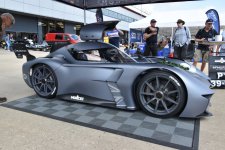
One thing I am convinced about is that EV`s are pug ugly , be they daily drivers of Hyper cars like the McMerty Speiling seen at Silverstone Classic this weekend . It looks like a cast off from an old FlashDSC_0971.JPG Gordon movie !
 

Yellowshark

Well-known user
Interesting subject. With 2030 in mind I had a look last year, at the new Fiat 500e and the MINIe, both vastly inflated prices over the petrol versions. Why would anyone want/indeed afford to spend such a large premium apart from the top 10%, I have no idea if TODAY it is cheaper to fuel a car with electricity rather than petrol. I have no idea when us mortals will be able to buy an E car that has a mileage range that means you can actually drive somewhere without worrying all the time. With my C5 I can.

I see little in the press about how much a new battery would cost. I doubt there is anything in my C5 that would cost anything near an E battery cost. Lots of E chargers in my local town centre car park, i.e. 4. What happens when we are all driving electric – no need to worry about poor mileage range if you cannot get any electricity into your battery.

Do I contribute to the planet? Yes, before I retired I paid higher tax rate for many years and top whack of NI, I never claimed a benefit and so the Government coffers have done well from my contribution. Am I going to continue to contribute? Yes I just bought a 2nd hand MINI Cooper S Works as my daily driver which has a better mpg than the C5. My strategy is based on the assumption that before they stop selling petrol I will have departed the planet
 

Roscobbc

Moderator
There's an article in the Telegraph this weekend with the headline "electric cars will cost more than petrol to run" - haven't read it so can't comment on the content.
Logic tells me that with our every increasing energy costs (electric) that even with the very best best supply 'deals' the cost advantage of running an electric vehicle will be eroded in future years, perhaps significantly.
I was looking at the spec's of the new MG4 - at between ÂŁ25K and ÂŁ30K with its supposed 271 mile range it makes an interesting comparision with similar car priced perhaps ÂŁ10/ÂŁ15K more.......and the Chinese are rapidly improving their quality............but there I have to stop and look at the prices of not just electric, but ICE vehicles.....and they are simply crazy unless you are a higher mileage, every day user. I'm sure that people ultimately will except that a electric car, any electric car will in future be a ÂŁ25K + item.
ICE cars are so good now in terms of reliability, quality and useful life (a 15 to 20 year economic life isn't unusual) it makes running an older car for many lower mileage users a logical plan. And here's where the battery issue with electric vehicles falls down.....if we presume that an electric car needs a battery replacement at, say 10 years, and that battery cost is perhaps between ÂŁ7K and ÂŁ10K.......when it is time to sell your 10 year old electric vehicle do you sell it with a knackered battery? - or do you replace the battery before selling? - and will you recoup the cost of the new battery?. Its a bit like selling, for example a 10 year old VW Golf and deciding whether to replace the engine (at whatever cost) or sell it as is. A mute point perhaps as the VW is unlikely to have a worn-out engine at that age whereas the electric car is almost certainly likely to need a replacement...........but it shows the potential future problems selling a used electric vehicle.
 
Last edited:
Top