Recurrent misfiring problem

Oneball

CCCUK Member
I use this Gunson timing lamp. With the engine running I simply fit the inductive pick-up on each HT lead in turn and pull the trigger. If the light doesn't flash then that cylinder isn't firing. If the flash is sporadic or intermittent there's an occasional misfire.
If that is the case then your problem is almost certainly in the electrical system. There are very few non electrical issues that test would show up (flooded plugs for example)
 

antijam

CCCUK Member
If that is the case then your problem is almost certainly in the electrical system. There are very few non electrical issues that test would show up (flooded plugs for example)
I was much of your opinion. However, I've tested and swapped all the ignition parts separately. Everything is in spec and each item seems to be functioning correctly. The fact that all plugs fire satisfactorily outside the cylinder and my spark tester verifies an adequate voltage on all HT leads is leading me to think that the problem must lie elsewhere.
 

teamzr1

Supporting vendor
If the sparkplug gap is correct and your testing showed high voltages from coil than
it would have to be a makeup of the charge to the cylinder or dirty exhaust pulled back into the cylinders

Above points, I made and using a borescope to closely look at top of pistons and face of valves and seats
IF thinking there are misfires then be interesting to see the difference of AFR of B1 and B2 using
an AFR tester at muffler tips
 

Roscobbc

Moderator
I was much of your opinion. However, I've tested and swapped all the ignition parts separately. Everything is in spec and each item seems to be functioning correctly. The fact that all plugs fire satisfactorily outside the cylinder and my spark tester verifies an adequate voltage on all HT leads is leading me to think that the problem must lie elsewhere.
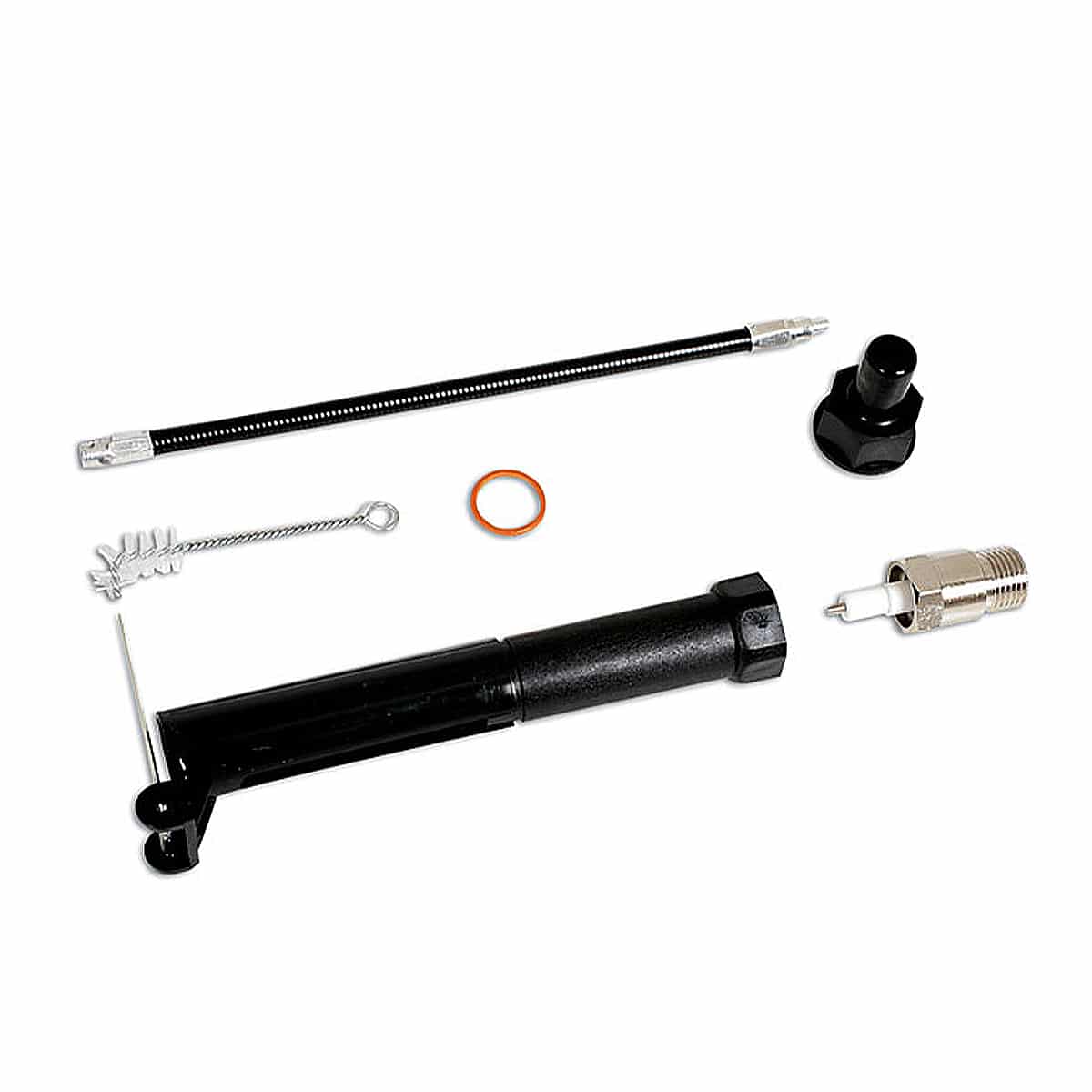
Remember the old Colourtune sparkplugs?. With it's glass (rather than ceramic) insulator you would adjust your ideal mixture to a perfect burn and see the 'burn' through the glass insulator. Of course you would have to repeat for multi-carb/choke engines but it could be used to 'visualise' and establish it individual cylinders had potential issues.
 

teamzr1

Supporting vendor
Interesting, never heard of this test tool before
Some info

Sold in the UK


antijam

CCCUK Member
Remember the old Colourtune sparkplugs?. With it's glass (rather than ceramic) insulator you would adjust your ideal mixture to a perfect burn and see the 'burn' through the glass insulator. Of course you would have to repeat for multi-carb/choke engines but it could be used to 'visualise' and establish it individual cylinders had potential issues.
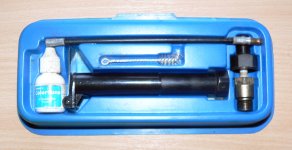
Yes indeed Rosco! - I didn't know they still made them? A rummage through my 'Tune-up' tool kit revealed this....

P1390256.JPG
...a near pristine Colourtune kit! It has to be something of a museum piece - the last time I used it must be more than 40 years ago! It was very useful in setting up old SU's - you could adjust the mixture very easily with the engine running.
 
Last edited:

Roscobbc

Moderator
Yes indeed Rosco! - I didn't know they still made them? A rummage through my 'Tune-up' tool kit revealed this....

View attachment 33078
...a near pristine Colourtune kit! It has to be something of a museum piece - the last time I used it must be more than 40 years ago! It was very useful in setting up old SU's - you could adjust the mixture very easily with the engine running.
I was going to add that were great for setting-up SU's or Strombergs - can't remember the viewing tube and mirror gizmo.....and yes its also more than 50 years ago used one. Shame we didn't start this conversation a few days earlier - had you not stripped the inlet off the engine you could have tried this on the 'iffy' cylinder.
Irrespective of that it would be interesting to try this of each cylinder in sequence to see how the air/fuel mixture is on each cylinder at idle........even when all is 100% there will be variations between cylinders.
 

teamzr1

Supporting vendor
If your borescope has a record video mode
Insert that AFR tool into 1 of the cylinders you think has misfire
Rig the borescope so it could record the tools color and go for a drive and check AFR under real-world conditions
and then replay the recording

This might also trap if there is any small cracks in a sparkplug arcing to ground
 

antijam

CCCUK Member
I was going to add that were great for setting-up SU's or Strombergs - can't remember the viewing tube and mirror gizmo.....and yes its also more than 50 years ago used one. Shame we didn't start this conversation a few days earlier - had you not stripped the inlet off the engine you could have tried this on the 'iffy' cylinder.
Irrespective of that it would be interesting to try this of each cylinder in sequence to see how the air/fuel mixture is on each cylinder at idle........even when all is 100% there will be variations between cylinders.
Trouble is it only works if the plug is firing. Even then using the viewing tube and mirror could be tricky in tight places. I'm trying to imagine getting a sensible view of the plug in #7 of an sbc with headers ! :unsure:
 

johng

CCCUK Member
Don't know if your's is the same, but my old Colourtune won't fit into the spark plug hole, the body is too wide.
 

antijam

CCCUK Member
Have you pulled the plugs out and compared a good cylinder with a bad one?
I pulled all the plugs to do the compression test and noted which cylinder each came from. The only visible difference of those from the non-firing cylinders was that they were wet with fuel.
 

antijam

CCCUK Member
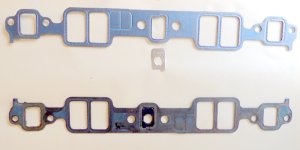
I'm preparing to re-install my intake manifold and I've noticed that both the old gaskets have heat crossover restrictors fitted. My new Fel-Pro gasket set comes with a restrictor for one side only and i'm wondering if this should actually be fitted and if so, in which side?

P1030458.JPG
(Old gasket below with restrictor fitted - new one above, without.)

The engine is running a stock Quadrajet carb with divorced coil choke on a stock cast iron manifold. It's fitted with headers so has no heat riser valve. Obviously the choke will benefit from some heat transfer to come off - and stay off - as quickly as possible but the carb itself however could well do without any excess heat to avoid early vapourisation in hot weather. ( I've had a couple of occasions when the engine cut out in very hot weather and slow traffic. Restart was only possible after raising the hood and waiting twenty minutes or so. Certainly indicative of vapourisation or percolation.). Modern ethanol loaded fuel is even more volatile than petrol so any potential vapourisation problems are more likely nowadays. I believe the original Quadrajet mounting gasket was a composite affair designed to minimise heat transfer from the manifold but this is very hard to find these days and very expensive if you can, so I have only a standard thick gasket to mount my carb.

There appears to be a trade off between allowing enough heat through to actuate the choke properly but not so much that there may be fuel percolation problems in the carb. :unsure:...Web wisdom suggests that with my set-up the best compromise is having the crossover restrictor fiitted but only in the drivers side gasket, leaving the passenger side clear.
So, unless anyone can offer a better suggestion, that's what I'll try.
 

Roscobbc

Moderator
I'd do exactly what you are already planning to do.........heated inlets IMHO are a double edged sword kinda thing - yes the heat would be useful for winter start-ups - but kiss of percolation death when warmed-up and in summer weather.
 

CaptainK

Administrator
I use an insulated "riser" type thing between my inlet and carb. I was getting percolation issues, don't any more. That was years back, and I've forgotten what the thing was called. I didn't go for a particularly tall one though, as some can be quite thick.
 

Roscobbc

Moderator
I get percolation in hot summer weather.....despite fuel pump with flow back to tank return and fuel lines wrapped with insulation. The 'clue' relating to percolation is to take a run when you have the problem and remove the air filter assembly.......and listen carefully. You'll perhaps hear a faint bubbling noise where the fuel in the float bowls is being pressured as it boils-up and pours into the intake plenem and puddles on the plenem base. Captain K's method is the best answer (if you have sufficient under hood height. A 1" resin or wooden spacer can dothe trick, eventually better is a 'sandwich' of alternate layers of thin plywood and aluminium sheet. Whether these are commercially available is another matter.
 

antijam

CCCUK Member
Finally got the intake manifold back on my engine. No longer having the strength to lower and accurately position the 40 lb. lump over the fender, I had to get creative. I dug out an old timber trestle, some blue polypropylene rope and an old screw jack and assembled them as a gantry to install the manifold. (Validating my motto 'Never throw anything away' :) ) Assembling this in the garage was going to be a tight squeeze so I pushed the car outside for more room. Positioned the trestle far enough back to open the hood.....
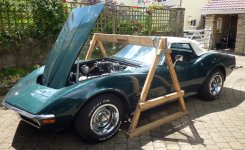
P1030461.JPG
then re-positioned it with the jack over the engine and slung the manifold.....
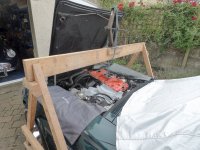
P1030467.JPG
A web trawl found that some bright spark had used sawn off bolts to help maintain the gaskets in position while fitting the manifold and I wondered if this idea could be extended to actually locate the manifold precisely. The problem is that the securing bolts are angled at 45° to the line of drop so straight dowels won't work; so i cut up four old 3/8" UNC bolts to produce these pins .....
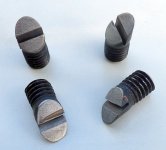
P1030465.JPG
The truncated shank is cut at 45° which, if orientated correctly when screwed into the head, will allow the manifold to slide down them into position. The slot is to be able to remove them with a screwdriver afterwards.
Positioned the manifold accurately over its final position on the engine, raised it with the jack and carefully cleaned the fitting faces of the manifold, the heads and the block...
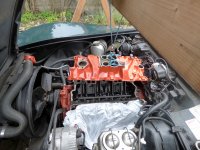
P1030518.JPG
I screwed my guide pins into the corner positions on the heads, carefully orientating the angled shanks, fitted the 'china wall' seals followed by the two gaskets, locatinng them over the pins. Many posts on the internet advocate discarding the 'china wall' seals and replacing them with generous beads of RTV, this theoretically being less prone to leaking. I see no reason not to retain the seals providing RTV is judiciously applied at the junction between the heads and the block, so that's what I did. I also smeared a thin layer of RTV around the water passage ports on both sides of the gaskets.
With all the seals, gaskets and guide pins in position I lowered the manifold into position with my 'jack' hoist. Guide pins worked a treat, helping to keep both the gaskets in position and precisely position the manifold; and with it seated they were easily unscrewed
Refitted the 12 securing bolts and torqued them down incrementally to 30 ft-lbs in the sequence below....
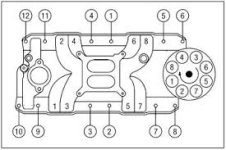
torque pattern.jpg
I used shim washers under the bolt heads to help ensure equal torque was actually transmitted to the threads and applied thread sealer to all the bolts. The central bolts protrude into the lifter valley and without sealer tend to leak oil onto the manifold.
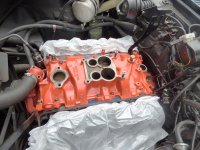
P1030519.JPG
All I have to do now is refit the distributor, carburettor, thermostat and a few other odds and sods; refill the coolant and fire her up !
If my misfiring is cured, then this was probably the problem. :) If it's not then I've at least eliminated one possible cause. :(

,
 

antijam

CCCUK Member
I get percolation in hot summer weather.....despite fuel pump with flow back to tank return and fuel lines wrapped with insulation. The 'clue' relating to percolation is to take a run when you have the problem and remove the air filter assembly.......and listen carefully. You'll perhaps hear a faint bubbling noise where the fuel in the float bowls is being pressured as it boils-up and pours into the intake plenem and puddles on the plenem base. Captain K's method is the best answer (if you have sufficient under hood height. A 1" resin or wooden spacer can dothe trick, eventually better is a 'sandwich' of alternate layers of thin plywood and aluminium sheet. Whether these are commercially available is another matter.

Adding heat insulation between the carb and manifold can only be a good idea. If you're using the original Quadrajet with divorced choke the problem with increasing the gasket thickness is that the choke will need a longer operating rod.
Untitled-1.jpg
I believe the original gasket for this carb was a composite affair with thermally resistant layers incorporated within the standard thickness. As I mentioned before, this gasket is difficult and expensive to source these days.
 
Top